One of the most common ants in Florida, odorous house ants, get their name from the rotten smell they give off when crushed. They often nest indoors near moisture sources and are attracted to sweets.
Continue reading
One of the most common ants in Florida, odorous house ants, get their name from the rotten smell they give off when crushed. They often nest indoors near moisture sources and are attracted to sweets.
Continue reading
Honey bees (Apis mellifera) are among the most important pollinators in the world, playing a vital role in ecosystems and agriculture. Known for their intricate social structures and honey production, these insects live in highly organized colonies that can persist for years. Understanding their behaviors and nesting habits can help you identify honey bees and coexist with them safely.
Queen honey bees are slightly larger than male honey bees, also known as drones. Worker honey bees, the most common colony members, are about 1/2 inch long with golden-brown bodies featuring black and pale orange or yellow bands on their abdomens. They have six legs, two pairs of translucent wings, and a pair of segmented antennae.
Queens are distinguished by their longer, more tapered abdomens, while drones are bulkier with rounded abdomens and no stingers. The bees’ dense hair-like structures help them collect pollen during foraging trips. This makes them vital to pollination.
The presence of honey bees is usually indicated by a constant buzzing sound or seeing bees flying in and out of a single location. Honey bee nests may be found in trees, walls, chimneys, or attics, where they build wax combs to store honey and house their colony.
Another sign includes honey dripping from walls or ceilings, which could mean a hidden nest inside your property. Swarming activity, where groups of bees move together to find a new nesting site, is another obvious sign of honey bee presence. Keeping this in mind will help with honey bee identification and spotting their nests.
Honey bees are adaptable insects that thrive in a variety of environments, from natural landscapes to urban areas.
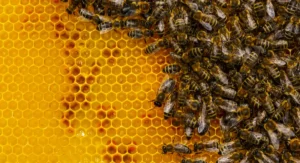
Honey bees are found all over the nation and pollinate more than 100 types of crops. They often build their nests in tree crevices, but will occasionally build nests in attics or chimneys. They are most visible in summer and late spring when new queens leave their old colonies along with thousands of workers to build new nests in tree hollows or crevices. At this time, large groups of bees can be seen swarming together to find a new nesting place. It takes a swarm approximately 24 hours to locate a new nesting site.
Honey bees can also be kept in an apiary, which is anywhere beehives are kept for honey production and honey bee conservation. Trained beekeepers ensure the honey bees remain healthy and productive while collecting the honeycombs they produce.
While most swarms are harmless, certain species of bees, like the Africanized honey bee, are extremely aggressive and may attack unprovoked.
Honey bees feed on nectar and pollen collected from flowering plants, collected using pollen baskets. These are small structures on the hind legs of the honey bees. Nectar provides them with carbohydrates for energy. The pollen supplies essential proteins and nutrients needed for growth and development.
The collected nectar is processed into honey, which serves as a food source for the colony during colder months when flowers are scarce. Honey bees also sustain themselves on bee bread, a combination of bee pollen, nectar, and saliva. Larvae and queen bees are also fed royal jelly, a milky substance made from pollen which is secreted through glands in their heads. Worker bees play an important role in gathering these resources to sustain the hive.
The honey bee life cycle consists of four stages: egg, larva, pupa, and adult. A queen lays eggs in individual wax cells in the hive, and depending on the diet fed to the larvae, they develop into workers, drones, or queens. Worker bees live for approximately six weeks during peak foraging season, while queens can live for several years. Drones, whose primary role is to mate with queens, die shortly after mating. The cycle continues year-round in warmer climates like Florida, with peak activity occurring in spring and summer.
Africanized honey bees and European honey bees are two of the most common species of bees found in Florida. The Africanized bees are much more aggressive. Honey bees are highly social and organized insects. Worker bees perform specific tasks such as foraging for food, caring for the young, and protecting the hive.
Honey bees make use of ocelli – three eyes on their head that can only detect light – to orientate themselves towards the sun and navigate. They communicate through movements known as the “waggle dance,” which helps other bees locate food sources. Honey bees also release pheromones through multiple glands to communicate and help recruit bees to the hive.
They are most active during the day and return to their hives at night. During swarming, honey bees temporarily group together while scouting for a new nest location. Despite their cooperative nature, honey bees will defend their colony if they feel threatened.
As with the mud dauber wasp, honey bees can sting but are unlikely to do so. Only female bees are capable of stinging and are not likely to sting when foraging for nectar and pollen in the backyard. They can also only sting once. Bee stings generally happen when these docile bees are provoked or accidentally crushed. The stinger of the honey bee, having barbs, will remain in the skin unless physically removed.
Removing the stinger as quickly as possible is the most important thing. The method of removing the stinger, either grasping with fingers, tweezers, or scraping from the skin, is up to the individual. Honey bee stings are quite painful and even life-threatening to a small percentage of people who are allergic to venom. If a honey bee nest is suspected on your property, it is always best to contact a professional bee removal company like Florida Pest Control.
The safest and most effective way to remove honey bees is to contact a professional bee removal service. Experts can safely relocate the bees and their hives without causing harm to the colony. Attempting to remove bees yourself can be dangerous and may provoke the hive. Avoid using pesticides, as they are harmful to honey bee populations, which are essential pollinators. If you notice a nest on your property, keep a safe distance and refrain from disturbing the bees.
To prevent honey bees from nesting on your property, seal cracks and crevices in walls, chimneys, and attics. Remove potential nesting sites such as hollow trees or unused equipment. Planting flowers at a distance from your home can encourage bees to forage away from living spaces. Regularly inspect your property for signs of bee activity and address any infestations promptly by contacting a professional.
If you’re dealing with honey bees, wasps, or hornets on your property, Florida Pest Control can help. Contact us today for professional pest control solutions tailored to your needs.
Yes, honey bees can sting, but only female worker bees are capable of stinging. Honey bees usually sting when provoked or threatened. After stinging, the bee’s barbed stinger remains in the skin, and the bee dies shortly afterward.
Honey bees are not officially endangered, but their populations face significant threats from habitat loss, pesticides, climate change, and diseases like colony collapse disorder. Efforts are being made globally to protect and support honey bee populations.
Honey bees swarm when their colony becomes too large for its current hive. This natural process allows the colony to split, with the old queen bee and a group of worker bees leaving to establish a new nest. Swarms are often seen in spring and early summer.
No, honey bees are not native to North America. European settlers brought them over in the 17th century. Native bees, such as bumblebees, have coexisted with honey bees since their introduction.
Honey bees are generally docile and not aggressive unless provoked or their nest or hive is threatened. They are focused on foraging for nectar and pollen and rarely sting unless they feel endangered.

Acrobat ants get their name from how they lift their abdomen above their heads when threatened. They often nest in moisture-damaged wood, insulation, or wall voids. Indoors, they’re drawn to sweets and protein-rich foods.
Continue reading
Commonly referred to as the red velvet ant or cow killer ant, the velvet ant (Dasymutilla occidentalis) is actually a solitary wasp belonging to the family Mutillidae. Due to a painful sting, tough outer skeleton, and foul-smelling chemical excretions, it appears that the velvet ant does not have any predators.
Velvet ant wasps get their name due to the fuzzy velvet appearance of females, which are wingless and often brightly colored. Their bright colors are actually a signal warning predators to stay away.
Female velvet ants are wingless and have a hard exoskeleton, while males have wings and are often mistaken for bees or other wasps. Females are equipped with a long, sharp stinger, which is actually a modified ovipositor (a tube used for both defense and laying eggs). Adults grow up to an inch long, making them one of the larger solitary wasps in Florida.
Velvet ant wasps are just one of the many species of stinging insects in Florida.
Velvet ants don’t live in colonies like other wasps, but seeing a few in your yard or near the nests of other insects could mean there are more nearby. Watch out for these signs:
If you encounter a red velvet ant, exercise caution. Their painful sting can be avoided by leaving them undisturbed. For safe and effective removal of velvet ant wasps, contact the experts at Florida Pest Control. Our team can handle the problem efficiently and help protect your home.
Understanding the habitat, diet, and behaviors of velvet ant wasps can help you identify them better.
Velvet ants typically live in warm, sandy environments such as fields, meadows, and open woodlands. They are commonly found in the southern United States, including Florida, where they thrive in dry, sandy soils. The velvet ant wasp is typically seen running around open areas, sometimes erratically, in late summer. They may be seen in lawns or pastures or wandering into buildings. Females usually search for host nests on the ground, especially on bare, sandy soil. Male velvet ants are often found on flowers.
Velvet ants are external parasites of bees and wasps, taking over their nests in the ground. A few species of velvet ants paralyze flies and beetles. Adult velvet ant wasps feed on nectar and water. Although uncommon, velvet ant wasps occasionally enter structures in search of prey.
Velvet ants start their life cycle when a female lays an egg inside a host insect’s nest, like a bee or wasp nest. When the velvet ant egg hatches, the larva feeds on the host insect’s larva or pupa. After feeding, the velvet ant pupates in a cocoon inside the host nest. New adults emerge in late spring or early summer to repeat the cycle.
Velvet ant wasps are solitary creatures and don’t live in colonies. Consequently, there are no identifiable nests to treat. They also make a squeaking noise when handled, which is another defense mechanism. Even though they look scary, velvet ants are not aggressive unless provoked.
They can be. Although velvet ants are very docile and rarely come into contact with people, the female velvet ant has a very potent and toxic venom. Males cannot sting and are harmless, but the females have an extremely painful sting, as suggested by the name “cow killer” given to some of the larger species.
A sting generally only occurs if they are accidentally stepped on. If a sting does happen, there is the possibility of a severe allergic reaction occurring in some people that will require immediate medical attention. Parents should educate their children to not handle them or touch them. For advice or assistance with velvet ant wasps in your property, contact your local wasp control experts.
The safest way to remove velvet ant wasps is to call a professional pest control service. Experts can locate where these wasps are hiding and safely remove them without risking painful stings. If you’re dealing with velvet ant wasps, contact our wasp experts at Florida Pest Control for safe and effective removal.
Follow these steps to help keep velvet ant wasps away:
If you have bees, wasps, or hornets around, it’s important to act fast. Insects like velvet ant wasps, yellowjackets and even the honey bee can be dangerous, especially if they feel threatened. Taking quick action can help keep your home and family safe.
Our bee, wasp and hornet exterminators at Florida Pest Control safely remove nests, prevent infestations, and protect your home from all stinging insects. Get your FREE quote today.
This is due to their tough exoskeleton, which helps protect them from many threats. Additionally, these wasps often stay hidden in the ground, making them harder to spot and remove.
Velvet ants aren’t poisonous, but their sting is extremely painful. The venom from their sting can cause discomfort and, in rare cases, allergic reactions.
Velvet ants are called “cow killers” because their sting is so painful that it’s said to be able to kill a cow, though this is an exaggeration.
Yes, female velvet ants sting. They use their powerful stinger to defend themselves or while hunting for prey, like beetles and other insects.
No, velvet ants are solitary wasps. Unlike many other wasp species, they don’t live in colonies and prefer to live alone, especially during the adult stage.

The cicada killer wasp may look intimidating due to its large size, but this solitary wasp is mostly non-aggressive toward humans. Found throughout Florida, cicada killer wasps play a crucial role in controlling cicada populations. While their burrowing habits can be a nuisance in lawns and sandy areas, they rarely sting unless provoked.
Cicada killer wasps (Sphecius speciosus) are one of the largest wasps in North America, measuring up to 1 ½ inches in length. This is one of the best giveaways in cicada killer wasp identification. They also have a black abdomen with distinct yellow bands, resembling a larger version of a yellowjacket. Their wings are amber-colored, and their heads and thoraxes are covered in fine reddish-brown hairs. The female cicada killers are larger than the males and carry a long stinger used to paralyze cicadas.
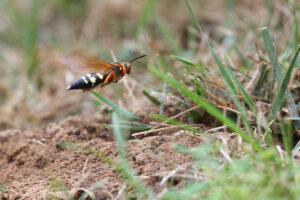
When spotting signs of cicada killer wasps, look for multiple U-shaped mounds of soil in lawns, gardens, flower beds, or along sidewalks. These piles are created when females dig their burrows and are a clear sign of these insects. You may also notice male wasps flying low over the ground, guarding nesting areas, or see females carrying paralyzed cicadas back to their burrows.
Understanding their habitat, diet, and life cycle can help you better appreciate these solitary wasps and their impact on the environment.
Cicada killer wasps prefer sunny areas with sandy or loose, well-drained soil. Their nesting sites are commonly found in lawns, gardens, golf courses, and along patio edges, flower beds, or walkways. These wasps favor areas where cicadas are abundant.
Adult cicada killer wasps feed on nectar and sap from flowers, making them occasional pollinators. However, their grub-like larvae depend entirely on cicadas for nutrition. Female cicada killer wasps paralyze cicadas and drag them into underground burrows, where they serve as food for the developing larvae.
The life cycle of cicada killer wasps begins in the summer when females create burrows and lay eggs on paralyzed cicadas. Each egg hatches into a larva, which feeds on the cicada provided by the female. Once the larva has consumed the cicada, it pupates in the burrow and overwinters underground. Adults emerge in late June or July to start the cycle again.
Unlike more social wasps, cicada killer wasps are solitary insects and are generally non-aggressive toward humans. Female wasps primarily focus on excavating burrows in the ground and hunting cicadas to provide food for their larvae. They are typically too preoccupied with their tasks to pose a threat. Male wasps, on the other hand, patrol the nesting areas and may appear aggressive as they chase away potential intruders.
Unlike other wasp species, cicada killers are not very aggressive and rarely sting humans or pets unless they are disturbed. Males are aggressive and territorial but do not possess a stinger. A sting from a cicada killer wasp can be painful and their venom may cause an allergic reaction in some people. Like a bumblebee or a yellowjacket, the cicada killer wasp can sting more than once.
Cicada killers can be a nuisance if they are found on your property. Female wasps dig fairly large burrows, making quite a large mess near plants and vegetation. The burrowing behavior of this wasp can damage the roots of plants and make some structures, like walkways and pathways, unstable. If you are dealing with a cicada killer wasp problem, contact your local wasp removal experts for help.
If cicada killer wasps, or any other common species of stinging insects, have become a problem on your property, professional pest control services are the most effective solution. Experts can safely locate and remove burrows while minimizing damage to your lawn or garden. In the meantime, you can discourage their activity by keeping soil moist and compact, as they prefer loose, dry soil for burrowing. Avoid trying to handle these wasps on your own, as disturbing their nests may provoke defensive behavior.
To prevent cicada killer wasps from nesting on your property, take steps to make your outdoor areas less inviting:
Dealing with bees, wasps, or hornets can be overwhelming and potentially dangerous. Florida Pest Control offers expert services to safely and efficiently manage infestations of stinging insects. Whether it’s a cicada killer wasp issue or another type of pest, our trained technicians use proven methods to protect your home and outdoor spaces. Contact us today for a thorough inspection and customized pest control solutions.
Cicada killer wasps rarely sting humans unless they feel threatened.
Cicada killers are not very aggressive. Males are territorial but cannot sting, while females sting only if provoked.
A sting from a cicada killer can be painful and may cause swelling or an allergic reaction in some individuals. Seek medical attention if symptoms worsen.
Cicada killers are active during the summer and typically disappear by late August or early September.
It’s best to contact a pest control professional to safely remove cicada killer nests. Avoid disturbing the nest on your own, as this may provoke the wasps.
Cicada killer nests are burrows in the ground with a U-shaped soil mound surrounding the entrance. These are often found in dry, sandy areas.

Carpenter bees (Xylocopinae spp.) get their name from their habit of boring into wood, creating chambers to raise their young. These solitary insects drill perfectly round holes in untreated wood to create nests, weakening decks, fences, and eaves over time. Read on for more carpenter bee information and learn how to identify, prevent, and control carpenter bees to protect your property.
Along with bumblebee queens, carpenter bees are the largest native bees in the United States. They are often mistaken for bumblebees due to their similar size and coloration, but they have key differences in appearance. This means carpenter bee identification isn’t difficult. They are large, measuring between ½ inch to 1 inch in length, with black and yellow coloring. Unlike bumblebees, carpenter bees have a shiny, hairless abdomen compared to the fuzzy, hairy abdomen of bumblebees.
Carpenter bee infestations have some distinctive telltale signs. Look for round, clean holes about ½ inch in diameter in wooden structures, such as siding, decks, or eaves. These holes are entry points to the tunnels where females lay their eggs. Sawdust, also known as “frass,” may be seen directly below the holes. You may also notice yellowish staining near the entry points. This is caused by the bees’ excrement.
Male carpenter bees hovering aggressively around wooden surfaces are another sign of an active infestation.
Unlike social bees, carpenter bees prefer to nest alone, boring into wood to create their homes. Read on for more information about their habitat, diet, life cycle, and behaviors.
Carpenter bees can be found across the southern United States and are a common bee species in Florida. They are not social insects, creating individual nests in trees, eaves, or sides of structures.
Males and females overwinter in old nest tunnels and emerge in the spring to mate. The mated female selects a suitable piece of wood for nest construction while the male spends most of their time hovering near nest sites. The female excavates a gallery using her mandibles (jaws). She then furnishes her nest with “bee bread” (a mixture of pollen and regurgitated nectar). Then she deposits an egg and closes the cell with chewed wood pulp.
Carpenter bees primarily feed on nectar and pollen from flowering plants. They are effective pollinators and are often seen visiting flowers in gardens, fields, and wooded areas. Unlike termites, carpenter bees do not consume wood. The female excavates wood only to create nesting galleries for her eggs. The bee’s diet remains strictly floral.
The life cycle of carpenter bees begins when females lay their eggs in the galleries they excavate in wood. Each egg is placed within an individual cell, separated by partitions of chewed wood pulp. Once the eggs hatch, the larvae feed on the “bee bread” provided by the female. After pupating, the young bees emerge as adults, typically in late summer or early fall. These adults spend the winter in existing tunnels and re-emerge in the spring to repeat the cycle.
Carpenter bees are solitary by nature, unlike other bees that form large colonies. Females are focused on nest building and egg-laying, while males patrol and protect the nesting site. Although male carpenter bees cannot sting, their aggressive hovering behavior can be intimidating. Carpenter bees are most active during the spring and early summer months when mating and nesting occur. This is when they are often found near wooden structures, hovering close to potential nesting areas.
Female carpenter bees are rarely aggressive but will sting if provoked. If a person is stung by a carpenter bee and is allergic to bee venom, they should seek immediate medical attention. Male carpenter bees do not possess a stinger, but can be extremely defensive when protecting and defending their nest.
Although carpenter bees can be helpful pollinators, they can cause significant damage to structures. Windowsills, wooden siding, decks, railings, outdoor furniture, and fences can be attacked. While the damage to wood from the excavation of individual carpenter bees may be slight, the activities of numerous bees over many years can result in considerable destruction. If you suspect a carpenter bee infestation, it is recommended to contact a bee control professional.
Carpenter bees can be difficult to remove without professional assistance. One of the best ways to address an infestation is to fill and seal their entry holes with wood filler or caulk. This can help prevent further activity. This should be done in late summer or early fall after the bees have left the nest.
Applying insecticidal sprays or dust inside the holes before sealing can also help remove any remaining bees. However, removing carpenter bees requires caution to avoid accidental stings. For severe infestations or to prevent future damage, contacting a pest control professional is recommended.
There are a number of ways to prevent a carpenter bee infestation:
If carpenter bees are causing damage to your property or if you’re concerned about their presence, Florida Pest Control can help. Our experienced professionals provide safe and effective bee removal services to protect your home and wooden structures. We offer free estimates and use eco-friendly methods tailored to your specific situation. Contact us today to schedule an inspection and keep your property pest-free!
Yes, carpenter bees are excellent pollinators. They feed on nectar and pollen from flowering plants, playing an important role in the pollination of crops, gardens, and wild plants. They’re great pollinators because of their large size and ability to perform “buzz pollination”.
Male carpenter bees can be very aggressive when defending their nesting area, but they do not have stingers and cannot cause harm. Female carpenter bees are not aggressive and typically only sting if they are directly handled or feel threatened.
Carpenter bees excavate tunnels in wood to create nests for their young. While they do not eat the wood, this behavior can lead to structural damage over time. Aside from nesting, carpenter bees are also pollinators, feeding on nectar and pollen from flowers.
Only female carpenter bees have stingers. They are capable of stinging but are not aggressive and usually only sting if they are provoked. Male carpenter bees do not have stingers, though they may hover aggressively to defend their nesting area.
Male and female carpenter bees can be distinguished by their appearance and behavior. Males have a white or yellow patch on their face and lack a stinger. Females, on the other hand, do not have this facial marking and are equipped with a stinger. Males are more aggressive and are often seen hovering near nests. Females are focused on nest-building and egg-laying.

Bumblebees (genus Bombus) are essential pollinators that play a vital role in Florida’s ecosystem. Larger and fuzzier than honey bees, bumblebees are known for their gentle nature, only stinging when provoked. While generally beneficial, bumblebees can sometimes build nests in inconvenient locations, leading to potential concerns for homeowners. Understanding their behavior and habitat can help determine the best approach to coexisting with these important insects.
Bumblebees are large and robust insects covered with densely branched setae (hairs). They have short stubby wings and are beneficial as pollinators for many kinds of crops and ornamentals. According to the National Wildlife Federation, their wings beat at least 130 times per second. The beating helps vibrate flowers until they release pollen, which is called buzz pollination. Buzz pollination helps plants produce more fruit.
Struggling with bumblebee identification? Check out our bees, wasps, and hornets identification guide.
If you spot increased bumblebee activity around your home or garden often, you might have an infestation. This is especially true if you see increased activity near ground-level cavities or structural voids. You might also notice bees around patio stones, piles of compost, or under decking. If their nest is nearby, you may see workers entering and exiting a single location repeatedly throughout the day. Hearing a buzzing sound near walls, attics, or decks could also indicate their presence.
While bumblebees are generally not harmful and are valuable pollinators, a nest in a high-traffic area can be a concern. If removal is necessary, it’s best to consult a professional pest control service.
Understanding bumblebees’ nesting habits, diet, lifecycle, and behaviors can help you appreciate their importance and know what to expect if they take up residence near your home.
Bumblebee colonies are small, containing a dozen to a few hundred workers. Most bumblebees nest in the ground, using deserted rodent burrows and shallow cavities. This might be beneath patio stones, landscaping timber, piles of compost, and within dense patches of grass. Above ground, they might live in abandoned bird nests and fiberglass-insulated structural voids. This could be in outside walls, patio roofing, and decks.
Bumblebees feed on nectar and pollen from flowers. Nectar provides them with energy, while pollen is an essential source of protein to feed their larvae. Bumblebees are particularly important for pollinating plants like tomatoes, berries, and peppers. This is because they are able to carry out buzz pollination, a process that helps release pollen from flowers more efficiently.
A bumblebee colony starts with a single queen in the spring. After emerging from hibernation, the queen builds a small nest and lays her first batch of eggs. These eggs hatch into worker bees, which take over foraging and caring for the colony. The colony grows through the summer, with the queen continuing to lay eggs. By late summer, the colony produces new queens and male bees for mating. After mating, the new queens hibernate, and the rest of the colony, including the old queen, dies off in the fall.
Bumblebees are active pollinators, flying between flowers and plants to gather nectar and pollen. Unlike some other bee species, they are not overly aggressive but will defend their nest if they feel threatened. Bumblebees are also adapted to colder temperatures, allowing them to forage in weather conditions that might deter other insects.
Bumblebees are peaceful insects and only sting when provoked. Most stings happen when their nest is disturbed. Only female bumblebees sting and unlike honey bees, they can sting more than once. Bumblebees can sting multiple times, but they do not form swarms like honey bees. The pain from a bumblebee sting is less painful than a honey bee sting, however, a sting can be dangerous if it occurs on the head or neck, or if an individual is allergic to their venom.
If you notice bumblebee activity, you should avoid disturbing the nest. Because bumblebees will sting when threatened, homeowners are advised to seek out a professional bee removal service rather than try to address the infestation themselves.
Bumblebees often nest in ground cavities, abandoned rodent burrows, or structural voids such as soffits and wall gaps, so a professional inspection is crucial for determining whether removal is necessary. While bumblebees are usually docile, they may defend their nest aggressively if disturbed, which is why licensed experts can best evaluate the risks and employ the safest, most humane approach—relocating colonies whenever possible or removing them if absolutely required. Trained pest control professionals like Florida Pest Control can help safeguard both your household and these vital pollinators.
To prevent bumblebee infestations, seal all cracks and openings in your home, especially around windows, doors, and siding. Remove piles of debris, compost, and unused wood where bumblebees might build nests. Keep landscaping well-trimmed and avoid leaving areas of tall grass or dense vegetation unattended.
If you’re dealing with bumblebees or any other stinging insects near your home or property, Florida Pest Control is here to help. Our team of experienced exterminators specializes in safe and effective bee removal services, ensuring the safety of your family and home. Contact us today for a free estimate.
Yes, female bumblebees have stingers and will use them to defend themselves or their nest. Unlike honey bees, they can sting multiple times without dying.
Yes, bumblebees make honey, but only in small amounts. They produce just enough to sustain their colony, unlike honey bees which store large quantities for winter survival.
Bumblebees don’t have traditional hives like honey bees. Instead, they build small nests, often in the ground, abandoned rodent burrows, or cavities in structures.
Bumblebees have six legs, like all insects. These legs help them collect pollen and navigate their surroundings.
No, bumblebees do not die after they sting. Their stingers are smooth, allowing them to sting multiple times without harm to themselves.

Harvester ants are outdoor nesters that feed on seeds and small insects. Their nests are often found in sandy soil with large, bare areas around them. Though they rarely enter homes, their sting can be painful.
Continue reading