Skip to content

Fire Ants in Florida: What You Need to Know

Fire Ants: Florida’s Red Menace

Quick Facts About Fire Ants in Florida

  • Fire ants deliver painful stings, can attack in large numbers, and may cause dangerous allergic reactions.
  • Florida’s warm, humid climate supports fire ant populations, which often build outdoor mounds in lawns, parks, fields, and along concrete edges.
  • Fire ants are dull red, 1/8–¼ inches long, with two bumps between the abdomen and thorax; their mounds can reach up to 18 inches high and have no opening at the top.
  • Disturbed fire ant mounds trigger a coordinated attack, with ants emerging together and stinging repeatedly.
  • Queen fire ants can lay up to 800 eggs per day, producing colonies of 100,000–500,000 ants with extensive underground tunnels.

Jump to:

What Fire Ants Look Like
Where Fire Ants Live In Florida
How Dangerous Fire Ants Are
Fire Ant Mound And Colony Behavior
Professional Fire Ant Control Services

Fire ants are a serious threat throughout Florida, known for their painful stings and aggressive colony behavior. These reddish ants thrive in the state’s warm, humid climate and often build large mounds in yards, parks, and other open areas. Because their colonies can contain hundreds of thousands of ants, and they attack in groups when disturbed, recognizing fire ant activity early is essential for safety. Florida Pest Control provides expert identification and safe removal to help protect your family and property from these dangerous pests.

Are There Fire Ants in Florida?

Yes, there are fire ants in Florida. Fire ants’ range stretches across most of the southeastern United States.

Are Fire Ants Dangerous?

These small, yet powerful, insects bite and sting approximately 14 million people each year. For most people, fire ant bites are not a big deal. They will hurt but you are unlikely to need medical attention. However, for those hypersensitive to bug stings, the venom from these ants can be life-threatening. Additionally, getting large numbers of bites can be highly dangerous to people. If you’re ever attacked by fire ants and start feeling tightness in your chest, difficulty breathing, or onset of an allergic reaction, seek immediate medical care.

What Do Fire Ants Look Like?

Fire ants measure from 1/8 – ¼ inch and are a dull red color. Fire ants are most known for their stinger, which in accordance with their aggressive nature, can lead to bad encounters. Fire ants are best recognized by two bumps that they have between the abdomen and thorax.

The easiest way to identify fire ants is through their mounds. These mounds range in size—some are small bumps, others can be up to 18 inches high. If you run into a fire ant mound, it won’t feature an opening on the top like other ant mounds. A mound that is about 7 inches high can house over 200,000 ants, which is precisely why these ants pose such a huge threat.

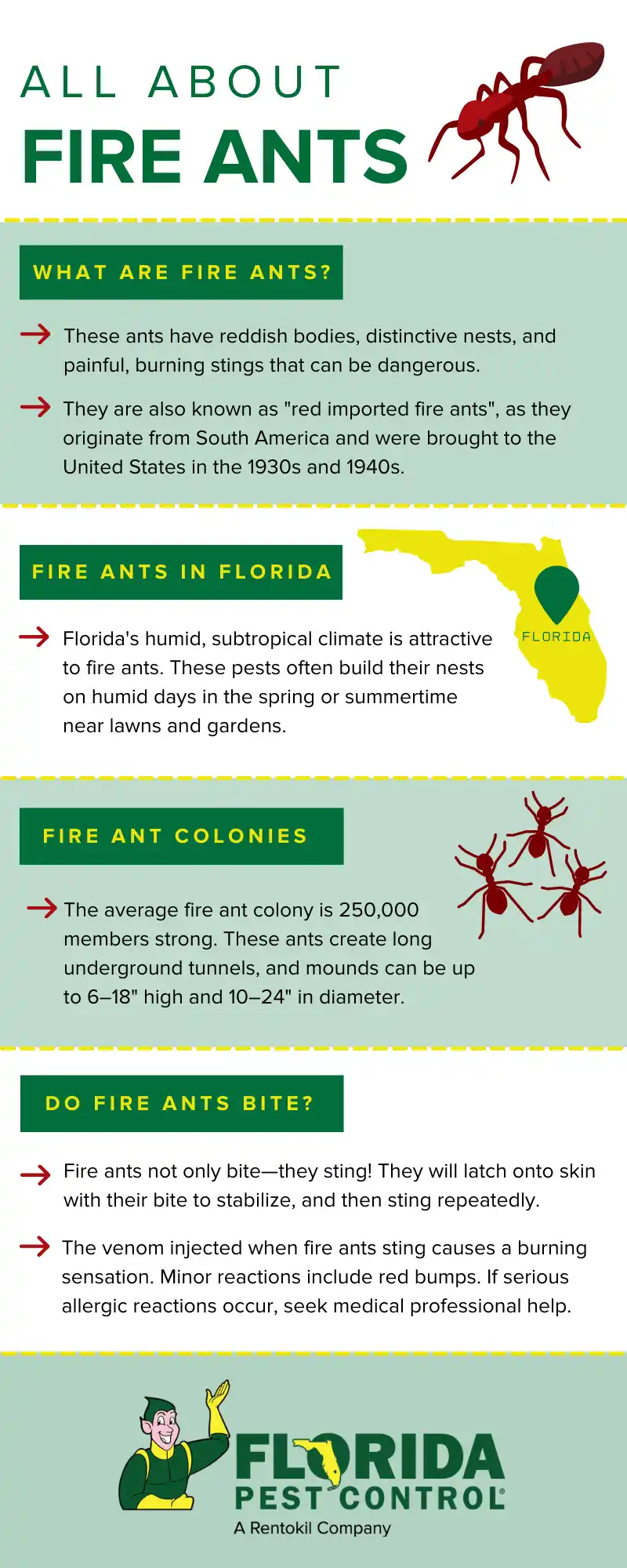
Fire ant infographic in Florida - Florida Pest Control

5 Facts About Fire Ants

Fire ants differ from your typical house ant in a number of ways. The most important things to know about these potentially dangerous pests include:

  • If a fire ant mound is disturbed, they will attack as one unit. When disturbed, the ants will begin spilling out ready to attack—and each ant will sting repeatedly.
  • To begin a fire ant colony, queen fire ants mate with males, killing the male in the process, and fly to the site at which she’ll begin the new colony. The queen will lay up to 800 eggs per day, growing the colony to an average size of 100,000 to 500,000 ants.
  • Fire ants don’t bite—they sting! Their stings can result in a burning sensation, hence their name. The sting site may swell and itch. A small pustule sometimes develops where the stinger enters the skin.
  • If fire ants get on you, it’s important to quickly and repeatedly brush them off your skin. The ants can latch on tight, meaning shaking won’t repel them. If you develop symptoms from fire ants, it’s important to seek medical attention.
  • Fire ants typically nest outdoors in open areas. Parks and fields are usually primary targets, but yards can be as well. The mounds are often found lining your grass and concrete, and they typically form on humid days.

Fire Ant Control in Florida

Trying to get rid of a fire ant mound yourself is dangerous. Their colonies extend far under the ground and feature multiple queens. If you have noticed a fire ant mound grow in your yard, the safest and most effective solution is contacting your local ant control experts to get rid of them.

4 Tips to Prevent Summer Lawn Pests

Grubs are a common summer lawn pest in Florida lawns - Florida Pest Control

Here in Florida, maintaining a healthy and lush lawn doesn’t come without its troubles. With our climate, it can be difficult to keep a lawn in good shape throughout the seasons—especially in the warm summertime. To make matters worse, lawn pests are a common nuisance dealt with by homeowners all year long. Lawn insects target grass and yards that are unkempt and unhealthy to begin with, making it all the more important to take proper care of your lawn and grass. The lawn care experts at Florida Pest Control are dedicated to helping our customers achieve a green, healthy lawn. We’ve provided our top 4 tips to prevent summer lawn pests to assist you.

Summer Lawn Pests in Florida

Florida is home to many types of pests, including a number of lawn pests! These insects commonly live just under the grass in your lawn, making it difficult to notice them until they’ve done their damage. Here are the most common lawn insects in our region during the summer:

  • Sod webworms chew through small areas of grass. They create tunnels out of their silky web that will run under the grass. Signs to look for include raggedly-chewed grass and smaller brown spots- around the size of a baseball.
  • Armyworms are small caterpillars that grow into moths. The females lay up to a thousand eggs at once in patches of fresh grass. These can hatch as quickly as 2 days. To spot these guys, you’ll want to look on the outside of dead or damaged grass areas.
  • Chinch bugs attack your lawn by sucking the liquid out of grass blades. In doing so, patches of grass on your lawn will dehydrate, turn yellow, then brown and die.
  • Mole crickets feed on and chew through the grassroots, causing your grass to die off. When dealing with mole crickets, your grass will feel spongy when stepped on and be covered with brown patches.
  • Grubs are beetle larvae that remain dormant through the winter. In the spring, they make their way toward the surface to feed on grassroots.

Top Tips For Lawn Pest Prevention

The key to lawn pest control is prevention. The key to preventing lawn pests is taking care of your yard! To ensure your lawn is healthy, thriving, and pest-free, follow these tips:

  1. Learn how to properly mow your lawn. Long grass that is never cut will attract all types of pests and weeds. Mowing your lawn in a timely manner will deprive lawn insects food and shelter.
  2. Avoid over- or under-watering your lawn. Pests of all kinds love moisture. If your lawn is soggy from overwatering, you are sure to create a haven for lawn pests. Learn how to properly irrigate your lawn depending on the season.
  3. When you see weeds, remove them! Wild, unkempt weeds attract a number of insects and pests. Weeds also negatively affect the health of your grass, leading to a number of diseases and problems.
  4. Fertilize your lawn as needed. Similar to your irrigation system, failing to fertilize your lawn correctly can lead to a plethora of problems. A lawn made unhealthy due to over-fertilization can contribute to pest problems.

Your Local Lawn Pest Control Experts

At Florida Pest Control, we know how frustrating it can be to diagnose your lawn problems. If you think you have a lawn insect problem, our lawn care experts can help. Contact us today to get started!

Pest Control is an Essential Business

florida coronavirus seal - keep pests away from your home with florid pest control

As communities around North America band together to determine the best course of action to stop the spread of Coronavirus (COVID-19), I wanted to reach out to let you know how Florida Pest Control is planning to move forward during the coming weeks.

As it always is, our mission is to protect and enhance lives by providing safe, reliable pest control to keep your homes or businesses pest-free. As such, we want you to know that we are here to serve you and are conducting scheduled services without interruption.

With many cities and states ordering shutdowns of non-essential businesses, in most areas, Florida Pest Control is able to continue operations because pest control is considered an essential service critical to the protection of public health. Rodents and insects that can invade your home and yard can carry and spread diseases to you, your family, and your pets. In addition to homes, we also provide pest control to businesses that serve the public, such as hospitals and grocery stores, as well as critical organizations in the supply chain, such as pharmaceutical facilities, food processing, and consumer goods manufacturers.

Our Pest Specialists remain equipped with all needed materials to ensure that your service is conducted safely. In this time of heightened awareness, we are also taking the following additional steps:

Our business is adhering to U.S. Centers for Disease Control guidelines to prevent the spread of the virus, including enhanced cleaning schedules at our offices.

We continue to regularly update and reinforce with our Colleagues the increased need for safety, sanitation, and hygiene measures, such as frequent hand washing.

Our teams are closely monitoring the need for additional resources in our branches in the event of increased call volume.

We’ll continue monitoring the situation and provide additional information should it become necessary.

Thank you for your continued business with Active. As your local pest control experts, we believe in the importance of community and are committed to working with our customers to ensure that their homes and businesses are protected from pests, even in these times of uncertainty.

Sincerely,
John Myers
President & CEO
Florida Pest Control

Winter Cold and Frost Damage

A patch of grass affected by frost damage - keep pests away form your home with florida pest control

With all that being said, if you suspect your lawn has received some cold or frost damage, there are some steps you can take to determine the extent. Start by raking the dead areas to expose the base of the grass. If it’s cold damage, all parts of the grass will be dead all the way down to the roots. With frost damage, the base of the grass will still be green.  Frost-damaged grass should recover when the spring warm-up rolls around. Any areas that have died should be renovated to prevent weeds from taking over.

A heavy layer of leaves still left on the grass can promote disease, so these leaves should be raked up or mowed. Mowing the leaves will allow the smaller pieces to decompose faster and return nutrients back into the soil.

Don’t be tempted to remove or prune a shrub that may appear dead or damaged from the cold. The brown leaves are just a sign of what is happening on the surface of the plant. If you scrape a small section of a branch, you’ll reveal what’s going on below the bark. If it’s green at the cambium layer, which is just below the bark, the branch is still alive. If it’s brown, then that part of the branch is dead.Some branches may fail to show signs of life in the spring while other branches are sprouting buds. If this occurs, you should prune back the dead branches on the shrub.  If you have plants that don’t respond in the spring, replacing those plants is recommended. Now is a good time to transplant shrubs while they’re still dormant. Transplanting during dormancy will help prevent the plant from going into shock, allowing a smoother transition into the spring greening.

Spring is a great time to fertilize your shrubs. Your shrubs will be healthier, look better and the fertilizer may even help in resisting next year’s cold weather. Florida Pest Control has a wonderful program that controls pests on your shrubs and fertilizes your shrubs, as well. For more information, contact us. Your shrubs will thank you for it!

Spanish Moss and Your Florida Landscape

Spanish moss hanging from a tree - keep pests away form your home with florida pest control

This is a very good time of year to evaluate the condition of your trees concerning the amount of Spanish moss they may have. Most will agree that a large oak tree draped with Spanish moss is a familiar image of the “Old South.” However, in many cases the limbs are heavily laden with moss and many twigs have no leaves because the moss is competing for space on the limb. The tree may be struggling and the moss is contributing to a slow decline. Consider the following moss facts:

  • Spanish moss is an air plant.
  • Just like other air plants, Spanish moss receives its nourishment through photosynthesis and rainwater, not from the plant it’s attached to.
  • Moss will not kill the tree; however, it will compete for space on limbs and twigs.
  • Because moss adds considerable weight to limbs and twigs, broken limbs can occur, especially when the moss is wet.

So, how much moss is too much moss? How much is acceptable? That decision is entirely up to you. Florida Pest Control can apply a product that will control Spanish moss. This treatment is less expensive and more complete than hand pulling. If your trees are overwhelmed by Spanish moss and you’d like them treated, contact us.

Keeping Pets Safe During Pest Control Treatments

Keeping Pets Safe During Pest Control Treatments

When you have a pest problem, it’s likely you have a lot on your mind. And while it may be easy to overlook things when scheduling your appointment, keeping your pets safe should not be one of those things! Most treatment methods used for household pest control are pet-friendly, but there are still some precautions you can take.

Your first step should always be to speak with your pest control professional. They will be able to help you determine what treatment is necessary for your home, and what preparations should be made prior to your appointment.

Regardless of the scale of the pest control treatment, you should always make an effort to contain your pets, both for their safety and the safety of the pest control technician. Although your dog may seem docile and harmless around family and friends, she may not behave the same when a stranger enters her home.

Also, your pets may simply want to figure out what is going on with a stranger in their house – but it is this curiosity that could put them in a harmful situation during a pesticide application. An easy solution is to make sure that they are kept in a kennel or carrier while the pest control expert is in your home. If a carrier is not available, simply move them to an area of your house that will not be included in the pest service.

Most common household treatments are confined to cracks and crevices in areas of pest activity, but spraying for fleas and other more involved treatments may require extra considerations – possibly finding a safe place for you and your pet to stay away from home for a short time.

Different types of pets may require different preparations, and some pets are more sensitive than others. Based on the treatment being performed by your pest control professional, they will tell you any additional preparations to make.

Please inform your pest control expert of all the pets you may have living in your home. Oftentimes, we think of pets only as the furry four-legged variety, but birds, reptiles and fish are common pets as well. Making your professional aware of these friends with feathers or scales before your appointment will allow you ample time to prepare should they need to be removed from the home on treatment day.

When it comes to in-home services, it’s always a good rule of thumb to consult with the experts – pest control is no different. Florida Pest Control has a team of well-trained and certified professionals to help you make any necessary decisions, and make sure that your family is safe throughout the entire process.

How to Keep Bugs Out of Your Home

How to Keep Bugs Out of Your Home

If there’s one thing Floridians know, it’s that the heat outside can be brutal. If there are two things Floridians know, the second is usually that bugs are abundant. While there may not be much you can do about the heat – aside from staying in the A/C – there are some tips and tricks you can use to help make sure bugs won’t be bothering you inside of your home. 

Why Do Bugs Enter Your Home?

Pests are always searching for a place to thrive, and your home can provide a safe and comfortable environment. Bugs enter homes for various reasons, from finding food sources to seeking shelter from the elements. By identifying entry points and understanding what attracts bugs, you can better prevent a bug infestation before it starts.

Common Attractants Inside Your Home

Bugs are often drawn indoors by food, moisture, and shelter. Here are some common causes of bugs in your home:

  • Crumbs: Even the smallest crumbs or food particles left on counters, floors, or in hidden corners can attract a variety of pests. Ants, roaches, and even rodents can be drawn to these food remnants.
  • Pet food: Leaving pet food out overnight or in an open container can invite bugs into your home.
  • Spills: Food and drink spills, whether they’re sweet or savory, create a sticky mess that can quickly attract pests like ants, fruit flies, and cockroaches. Even spills that seem small can become a food source for insects.
  • Standing water: Bugs, especially mosquitoes and cockroaches, are attracted to moisture. Leaky pipes, standing water in sinks, and even wet towels or dishcloths can create a perfect environment for pests.
  • Trash and garbage: Garbage is one of the top attractants for pests like ants, roaches, and rodents. Leaving trash in open bins or failing to take out the garbage regularly can invite a variety of bugs into your home.
  • Clutter: Piles of paper, clothing, or boxes can provide shelter for pests. Cluttered areas, especially in basements, attics, or storage rooms, make it easy for pests to hide and breed. 

Environmental Factors That Encourage Bugs

Certain environmental factors make it easier for bugs to thrive in your home. Areas with poor drainage or standing water attract mosquitoes and other pests seeking moisture. Filth flies, such as house flies and drain flies, are often attracted to environments where waste and decaying organic matter are present. 

Homes located near wooded areas or large shrubs can also experience an influx of insects, as plants provide shelter and food for pests like ants, spiders, and beetles. And homes with unsealed cracks in foundations or walls create easy access for pests such as ants and termites. Pests often seek shelter in these gaps, especially during extreme weather conditions, such as intense heat or cold.

Seasonal Variations in Bug Activity

Here in Florida, pests remain active throughout the year, but their behavior shifts with the seasons. 

  • Spring & Summer: Peak Pest Season – As temperatures rise, bugs become more active. You are more likely to see mosquitoes and ants, particularly fire ants. Spiders are also often found indoors seeking shelter due to increased humidity, and termites are especially active in the spring. Of course, Florida’s flies are a particular nuisance during the summer months.
  • Fall: Transition and Preparation – As the weather cools, many pests seek warmth and shelter indoors. Cockroaches may enter your home to escape the cooler temperatures. Fleas remain active as long as it’s warm, often hitching a ride on pets, but they tend to peak in the fall. Millipedes also like to come out during this time, especially after periods of heavy rain when soil is moist.
  • Winter: Cooler Temperatures and Hidden Pests – Though Florida’s winters are mild, some pests still seek warmth inside. Silverfish, which thrive in moist areas like bathrooms and kitchens, can be found inside year-round, but may be more noticeable during the winter. Spiders are less active outdoors in winter, but may still hide indoors, particularly in corners or clutter. 

At Florida Pest Control, we offer regularly scheduled inspections to help you maintain your home year-round. Contact us today for a FREE quote, and see how we can help keep bugs out of your property.

Top Tips To Keep Bugs Out of Your Home

If you want to prevent pests in your home, you need to get good at pest exclusion. Pest exclusion is the practice of anticipating the factors that attract pests and working to eliminate them before they lead to infestations. Here are some measures you can take that will help set you up for success.

Dispose of Garbage Regularly and Securely

To prevent attracting pests, make sure to take out the trash regularly and use bins with tight-fitting lids. Garbage left outside can be a food source for ants, cockroaches, and other insects, so it’s essential to keep it contained. One of the more common pests you’re likely to encounter is the ant. They come in many different varieties, and each species has its own set of problems they can cause your home.

Store Food, Including Pet Food, Properly

Keep food sealed in airtight containers, and don’t leave pet food out overnight. Crumbs, spills, and exposed food sources can attract various pests, including ants and fruit flies. Open food packages, crumbs, and spills are easy targets for pests like ants, fruit flies, and cockroaches, which are drawn to exposed food sources. By properly storing food and cleaning up after meals, you eliminate these tempting food sources. This not only keeps bugs at bay, but keeps the food fresh.

Inspect and Seal Common Entry Points

Pests often find their way into homes the same way we do – through doors and windows. At least once a year it’s important to check up on these common entryways. Replace any weather stripping on doors, and look to see if there is any loose mortar around your windows or vents in need of repair. Make sure to caulk or seal any gaps to prevent pests from entering your home. Even small crevices can provide an easy entry for ants, spiders, and other crawling insects.

Trim Overgrown Foliage Near the House

Pests are sneaky and use anything they can to find a way into our homes, and that includes foliage. Trim back tree limbs and any other plants or shrubs that might be touching the side or roof of your house. This will reduce the chances of pests climbing the branches and eventually getting inside.

Manage Humidity Levels in Your Home

If pests do make it inside, we surely don’t want to make it cozy for them. Pests such as silverfish, flies and mosquitoes thrive in high humidity. Check crawl spaces and in your attic for humid areas. It’s good to dry them out and keep them well-ventilated, or use a dehumidifier in areas like basements and bathrooms. Moisture is a breeding ground for any number of things, so you definitely want to get rid of it as well as you can.

Install Window Screens and Door Seals

Ensure all your windows and doors are properly sealed and equipped with screens in good condition. Even the smallest gaps in window frames or damaged door seals can create easy entry points for pests like mosquitoes, flies, and other insects. 

Keep a Clean and Clutter-Free Environment

A clean, organized home is the first line of defense against pests. Clutter provides perfect hiding spots for insects and rodents, making it easier for them to sneak in unnoticed. Regular cleaning removes food scraps and crumbs that attract pests, particularly in areas like baseboards, under furniture, and around food sources. 

Even with these defense mechanisms, pests can continue to be a problem, and when that’s the case, it’s time to call in the professionals. We’ll help you build a home defense plan to ward off these pests once and for all. If you’d like to schedule a no-obligation consultation, give Florida Pest Control a call today.

Natural Remedies vs. Professional Pest Control

Popular DIY Solutions to Bug-Proof Your Home

Many homeowners opt for natural remedies for smaller-scale infestations as a first line of defense. These solutions can sometimes be effective in repelling and controlling pesky pests but are generally less effective than professional pest control.

One popular option is using essential oils such as peppermint, tea tree, or eucalyptus, known for their insect-repelling properties. These oils can be diluted with water and sprayed in areas where bugs tend to enter, such as windowsills, doorways, and baseboards. 

Diatomaceous earth is another popular natural remedy, particularly for insects like ants, cockroaches, and fleas. This fine powder, made from the fossilized remains of tiny aquatic organisms, dehydrates bugs when they come into contact with it. Apply by dusting the powder along your home’s entry points, cracks, and crevices. 

Some people use cinnamon or citrus peel as natural pest deterrents. Ants, for instance, dislike cinnamon, and some say placing it near food sources or along entry points helps keep them away. Similarly, placing citrus peel or using citrus essential oils around windows or doorways might help repel pests like spiders and ants.

Other natural solutions include vinegar, which can be used to wipe down surfaces and clean areas where pests may be hiding, and borax, which, when mixed with sugar, is used for killing ants and cockroaches.

Limitations of DIY Pest Control

While DIY solutions can provide short-term relief and may help reduce the number of pests, they often don’t address the root cause of the infestation. Many over-the-counter treatments and natural remedies only target the surface problem, or target one or two visible bugs, leaving the underlying issue unresolved. This means that bugs are likely to return once your natural remedy treatment wears off.

Also, DIY methods may not be effective for all types of pests, especially larger or more persistent infestations like termites, rodents, or cockroaches. These pests often require more specialized treatments and expertise. And if entry points are not properly sealed or hidden nests and breeding grounds are overlooked, the infestation can continue or worsen.

Benefits of Professional Exclusion Services

In a nutshell, professional pest control offers a more comprehensive and lasting solution to any pest problem. Equipped with the right tools and expertise, pest experts can target the specific pests in your home and apply more effective treatments. Professional services also include regular follow-up services to monitor and manage any potential re-infestations, ensuring long-term protection. 

For a worry-free home, trust Florida Pest Control to provide the expert care and proactive solutions you need.

Preventing Common Household Pests

Maintaining a comfortable and healthy living space means staying on top of potential pest problems. Fortunately, there are straightforward steps you can take to reduce the likelihood of common pests.

Keeping Ants Out

To keep ants from entering your home, focus on removing their food sources and minimizing their access. Clean up any crumbs or spills immediately, and store food in airtight containers. Ensure that your trash is properly sealed and take it out frequently. Keep outdoor areas around your home free from debris and standing water where ants might be attracted. Finally, inspect your home’s exterior for potential entry points, especially near the foundation, and take steps to eliminate those.

Preventing Cockroaches Indoors

Like most critters, cockroaches are drawn to food, moisture, and warmth. Keep your home dry and free from excess moisture by repairing leaks in plumbing and ensuring that sinks and tubs are properly sealed. Clean all areas where food is prepared or consumed regularly, ensure that pet food is stored properly, and keep trash in sealed containers and take it out regularly. Next, clear clutter around the home, particularly in areas like basements or garages, as these dark, hidden spaces are ideal for cockroaches.

Reducing Mosquitoes and Flies

The most important preventative measure for mosquitos and flies is eliminating standing water in and around your home. This includes checking items like plant saucers, birdbaths, and clogged gutters. Also, fix any leaks that could lead to water accumulation. Next, trim overgrown vegetation around your home to reduce areas where mosquitoes can hide. For flies, regularly clean and empty garbage bins, compost containers, and pet waste areas. 

Learn more about about Florida Pest’s residential fly control services. For more information about commercial solutions, see our Lumnia insect light traps.

Minimizing Spiders and Other Creepy Crawlies

Spiders thrive in undisturbed areas with easy access to food. As with the other pests, remove hiding places, keep your home clean, particularly in corners, basements, and attics. Vacuum often, wipe down baseboards and corners where webs may accumulate. Managing moisture levels inside your home can also discourage creepy crawlies.

Don’t Sit There!

Wasp infestation to an old recliner - keep pests away from your home with florida pest control

Wasps, such as yellowjackets, sometimes make their nests in the strangest of places! Depending on the species, they may nest in the ground, in the trees or anywhere in between. This increases the danger associated with them – you never know when you might suddenly come across one of their nests!

In August 2014, our Winter Haven office came to the rescue of an elderly woman who had yellowjackets nesting in her recliner, of all places! Fortunately the recliner was outside, but it still presented an extreme hazard to anyone or anything that might disturb it. As evidence, a cat had jumped onto the recliner days before it was treated and was stung to death by the wasps!

Led by Vice President Chad Frowick and Branch Manager Westly Bass, Team Winter Haven performed a thorough inspection of the nest area and developed their treatment plan. As wasps tend to be less active in the early morning and evening, they decided the best time to treat would be before dawn, when the wasps would still be in their nest. Treating the nest, itself, would be quite a challenge for the team. As you can see in the photo above, the nest protruded from inside the recliner. What you can’t see is the rest of the nest, which was underneath the home!

In order to keep safety a top priority during the treatment process, onlookers were kept at a distance and bee suits were worn by the applicators. These suits prevent stings from bees and wasps by encapsulating the wearer. Unfortunately, sometimes the insects still find a way to get in one last sting! Despite the hazards associated with treating the nest, our applicators faced it head-on and saved the day!

If you have a problem with stinging insects or other pests of concern, please contact us! We feel the safety of you and your loved ones is of the utmost importance!

How to Protect Yourself from Stinging Insects

Stinging insect prevention

Now that the warmer weather has begun to arrive, it’s important to be mindful of stinging insects and take the proper precautions. Insect stings can be very painful and disturbing – they can cause skin reactions and even moderate to severe allergies.

Stings can usually be treated at home; however, severe allergic reactions can occur and potentially require medical attention – making it extremely important to be protected. It’s always better to be safe than sorry.

Some ways to protect yourself from stings:

  • Wear light-colored clothing: Floral patterns and dark colors can be attractive to bees and wasps.
  • Wear protective clothing: Covering as much skin as possible will protect you. Long sleeves and pants are always a good idea when spending a lot of time outdoors.
  • Watch where you walk: There’s nothing worse than finding out you stepped into a fire ant mound – OUCH! When a nest is disturbed, fire ants will come out by the hundreds to defend their colony from intruders. They not only inflict a painful sting, but they will bite down on you, as well!
  • Avoid perfumes: Anything that has a strong scent can attract bees and wasps. These little insects love perfumed soaps, shampoos, deodorants, colognes, etc. You will be better off going for a neutral and natural scent.
  • Wear clean clothes: Insects are attracted to strong odors. Basic hygiene, such as bathing daily, may help you prevent a sting.
  • Keep areas clean: We’re starting to see a pattern. Insects are attracted to leftover foods, garbage, and dirty plates. Maintaining cleanliness and discarding food correctly will help you in avoiding these little insects. Be careful with sweetened beverage spills and food crumbs.
  • Keep calm: Sometimes when we see a bee or a wasp flying around, we tend to make rapid moves and start swatting. This is actually the opposite of what you should be doing; this will irritate them and you will have a higher chance of getting stung.
  • Wear bug repellant: If you’re going to be outdoors, make sure to apply an insect repellant, there are plenty of brands to choose from. Read the product label to see which one is best for you and your family.

If you follow these easy tips, you will have a better chance of avoiding a painful sting. And if you have any questions about what you can do to keep your home safe from these insects, feel free to contact Florida Pest Control today.

Winter is Gone and Spring Is On

Winter’s Gone and Spring Is On

Winter’s gone and spring is on! As a matter of fact, spring began on March 20th at 6:45 P.M. EDT. Another sign of spring is the start of Daylight Savings Time, which may be a good thing or a bad thing depending on how you look at it.

You may be wondering, with such a mild winter, what unusual weather are we in store for this spring and summer? This is what the Farmers’ Almanac is predicting, “April and May will be hotter than normal, with below-normal rainfall in the north and above normal in the south. Watch for an early tropical storm in mid-May.” Well, we definitely can use the rain!

Speaking of rain, did you know the average rainfall in Florida for April is usually less than 3 inches? That’s not very much rain for your lawn and shrubs to “spring” into spring! You may have to supplement your landscape’s needs with a little irrigation. Your lawn should receive 3/4 inch of rainfall or irrigation every 10 – 14 days during the spring growing season. Shrubs aren’t usually as thirsty as your lawn, so you should water them as needed, taking care not to overwater. Problems such as root disease and leaf spot could result from overwatering.

Now is an excellent time to replace the mulch around your shrubs and other plants. The mulch will keep the soil from drying out quickly and aid in reducing weed growth. Be careful not to pile too much up around the trunk of your shrubs. You’ll want to keep a mulch-free zone about an inch away from the trunk. This will allow the base of the trunk to breathe much easier.

If your Azaleas have finished blooming, now is a good time to prune them. You don’t want to wait too long to prune them or you’ll cut off the bud formation tips for next year.

Also, with the warmer weather, your lawn will begin to grow more rapidly. Be sure to keep mower blades sharp and never cut off more than 1/3 of the leaf blade with each mowing. According to research, one bag of grass clippings could contain up to 1/4 pound of organic nitrogen, so it’s good to leave your clippings on the turf. The clippings will decompose and return nutrients back into the soil. The Florida Friendly Best Management Practices for the Protection of Water Resources states to always remove clippings from impervious surfaces such as sidewalks, streets, and driveways. The nutrients in clippings become pollutants if allowed to enter storm-water systems and bodies of water.

If you have any questions about your lawn or shrubs, contact us. We will have the answers for you.

Is Itchiness Contagious?

Is Itchiness Contagious?

In our “What’s Bugging You” articles, we often discuss pests such as bed bugs, fleas, mosquitoes, and head lice. Just thinking about these pests can cause us to itch. Watching someone scratch themselves may cause us to feel itchy, too, but why? Scientists have no definitive reason for this psychosomatic phenomenon, but they have performed research on the topic and developed hypotheses.

There are several hypotheses as to why we itch when thinking about something itchy. One hypothesis suggested by scientists is that our skin is constantly itchy to some extent, but we suppress the feeling until something reminds us. Another suggests that our senses become heightened because of the idea something could be crawling on us, even though nothing is. The latter could have some merit. At least once in every Floridian’s life, we have had the cockroach bedtime home invader. We’re ready to go to sleep and we spy a roach in the bedroom. We swat at the roach and miss! The roach runs off and we can’t find it. As we lay in bed, our skin crawls as we anticipate Mr. Roach crawling on us in the night with his six spiny legs.

Scientists also have hypotheses on why we itch when we see other people scratching. One idea is based on empathy or “fitting in” socially. We want to be a part of the social group subconsciously, so we mimic their behavior. If someone yawns, we yawn. If someone scratches, we get itchy and scratch. Yet another possible explanation involves pest prevention. Seeing someone scratch could possibly mean they have parasites on them, such as fleas or lice. If they have parasites, our mind tells us we could too, so we begin to feel itchy. By scratching, we could potentially be removing any parasites on us.

Although the occurrence of itchiness induced by suggestion seems like a novelty, there is value behind the research being done by scientists concerning it. The data gathered is being used to determine the cause and, hopefully, the cure for those with medical conditions causing untreatable and uncontrollable itching. So, the next time you read about head lice and feel that itching sensation, know you’re not alone. Scientists are scratching their heads, too, about the phenomenon.

There’s a Fungus Among Us

A healthy lawn with patches of brown and white fungus - keep pests away from your hoe with florida pest control

During the cooler weather, your lawn may begin screaming out to you, “There’s a fungus among us!” Mind you, a lawn can’t talk with words but it can tell you something is wrong in other ways – namely, by showing symptoms of the disease. One commonly seen disease this time of year is Large Patch fungus.

What is the Large Patch Fungus?

This fungus affects all warm-season turfgrasses. It’s active when nighttime temperatures range from 60-75 degrees and daytime temperatures don’t exceed 85-90 degrees. These temperatures are usually seen in the Spring and Fall, but can also occur during mild Winters. Like other fungi, Large Patch also requires adequate moisture in its environment to thrive, so be careful of your irrigation practices.

This disease affects the blades of the grass and will not kill the entire grass plant. It typically begins as small patches that turn yellow, then brown, as the grass blades die. Just like the blob seen in sci-fi movies, Large Patch starts out small but can spread to create large damaged areas if not controlled. An interesting display of Large Patch fungus in a lawn is the “donut effect” it may create. In diseased areas, you may see a ring of rotten grass with some green grass in its center; hence, looking somewhat like a large unsightly donut pattern in your lawn.

As ugly as Large Patch can look, it’s important to remember this disease does not kill the entire grass plant. Over time, the rotten grass left in the wake of Large Patch fungus will naturally decompose and new grass blades will grow. Mowing will also remove the dead grass blades. It must be mentioned, though, that active Large Patch fungus can be spread mechanically. In the event an area with an active Large Patch is mowed, recommendations are for those areas to be mowed last and mowing equipment rinsed to prevent further spread of the pathogen.

In order to stop the spread of Large Patch in your lawn, a fungicide application should be made. This will only stop the spread of the disease though; it will not cause the grass to grow faster or green-up. New grass will grow in eventually, but this can be a slow process in the Fall and Winter, as turfgrass is heading toward its dormant period.

Keep in mind, there may be other causes for brown patches in a lawn. Insect damage and improper lawn maintenance practices could also be a culprit, as well as many other variables. If you see discoloration in a lawn and aren’t sure what the cause is, contact us for a complimentary lawn inspection.

×

The Easiest & Fastest Way to Manage Your Account

Get 24/7 access to your treatment history, scheduling, and technician notes. Keeping your home bug-free without the form fill.

TRACK SERVICES

See exactly when your next seasonal pest barrier is scheduled and view past visit dates.​

ACCESS DOCUMENTS

Download detailed pest activity logs, treatment summaries, and service notes after every visit.

REVIEW RECOMMENDATIONS

Review structural tips or preventative advice left directly by your technician to keep pests out.

VIEW & PAY INVOICES

Keep your pest protection plan active. Check balances and make secure payments instantly.

*Payment features available for eligible accounts.

Need to speak with someone? Our local support team is standing by to help.

Florida Pest Control logo

Book a Free Inspection

Fill out the form below and we’ll be in touch!

Florida Pest Logo

Pest Problem? We Can Help.

Choose an option to connect with an expert:

Current Customers: