
Spotted a wood roach or German cockroach in your home? Your first instinct might be to reach for the nearest insecticide, but reacting before taking the time to correctly identify the species could be a major mistake. Because these completely different pests require uniquely targeted treatments, applying the wrong strategy can easily allow a severe indoor infestation to multiply and run amok.
To help you build an effective elimination plan, this guide breaks down the physical characteristics, biological habits, and specific treatments for each species.
Quick ID Comparison
- Origin: Wood roaches are outdoor insects that enter homes by accident, whereas German roaches are indoor pests that depend entirely on human habitations to survive.
- Survival Indoors: While wood roaches dehydrate and die within a few days inside a home, German roaches thrive indoors and reproduce continuously.
- Light Behavior: Wood roaches actively fly toward light, but German roaches flee from light into dark cracks.
- Key Markings: Two dark stripes behind the head confirm a German roach, while a solid brown body—sometimes with cream-colored edges—confirms your suspect is a wood roach.
- Health Risk: Wood roaches pose no health threat, whereas German roaches can spread dangerous bacteria and trigger asthma and allergies.
Appearance: Color, Size, and Wings
German roaches (Blattella germanica) are light brown to tan and have two dark, parallel stripes running down the pronotal shield just behind their head, which serves as a highly reliable visual identifier. Measuring only about 1/2 to 5/8 of an inch, their small, oval-shaped bodies are specifically designed to slide into narrow wall cracks.
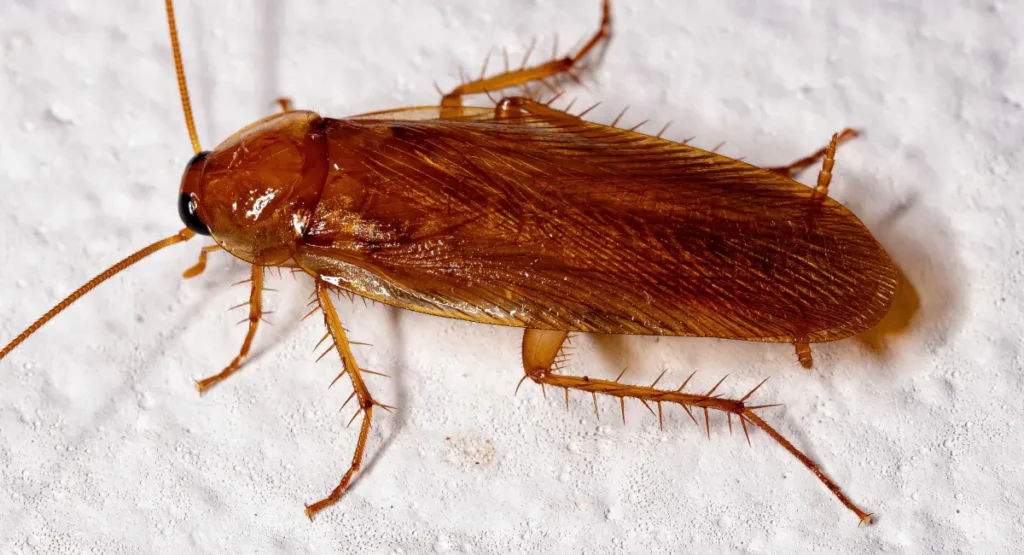
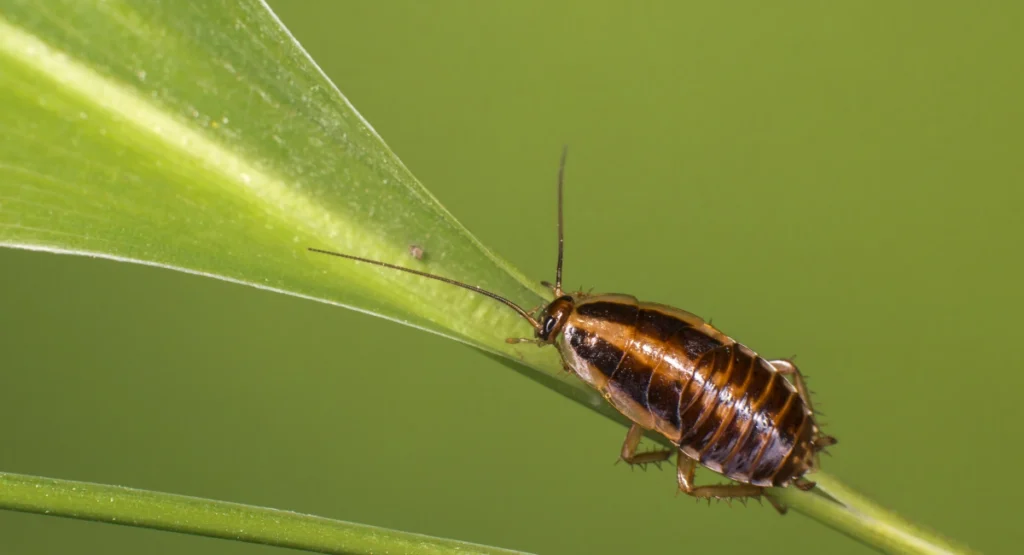
Wood roaches (Ectobiidae) share a classic cockroach profile: they are flattened, with spiny, splayed running legs, long antennae, and a head concealed from above. They are significantly larger than German roaches, reaching up to a full inch long, and typically feature a solid chestnut, mahogany, or dark brown color. Some species also display distinct cream-colored stripes located specifically on the outer edges of their wings and prothorax (middle body section).
Differences in gender and age are also evident in wood roaches: females have significantly wider abdomens and short, nonfunctional wing pads, while males have longer, thinner abdomens with clear wings that extend securely past their bodies. Furthermore, immature wood roach nymphs completely lack wings and often appear reddish-brown or distinctly bicolored.
Behavior and Flight
Although German roaches have wings, they almost never fly. Instead, they rely on speed to move rapidly along the ground, darting into deep crevices the exact moment a light turns on or they sense movement. Male wood roaches, by contrast, are highly skilled fliers during the spring and summer mating season, and are drawn toward porch lights, lit windows, and outdoor fixtures. Ultimately, an insect flying directly toward a light source is far more likely to be a wood roach than a German cockroach.
Habitat and Moisture Needs
The two species occupy entirely different environments because their biological moisture requirements are completely opposite.
Wood roaches live strictly outdoors where they naturally break down organic matter, congregating beneath leaf litter, rotting logs, loose tree bark, and clogged gutters. Because they need humid conditions to survive, the dry, air-conditioned environment of a modern home can be fatal to them.
On the other hand, German roaches are fully adapted to life indoors. Their basic biological need for warmth, moisture, and food drives their tendency to nest in dishwasher insulation, behind refrigerator motors, beneath kitchen sinks, and deep inside cabinet voids. They simply cannot survive outdoors in natural conditions.
Breeding and Infestation Risk
The respective reproductive rates of wood roaches and German roaches explain exactly why your response should vary based on proper pest identification.
Wood roaches breed very slowly and stay outdoors. Females deposit their egg cases in damp dirt or under organic debris during warm months, and the resulting nymphs take at least a year to fully mature. They absolutely cannot reproduce inside human homes due to the lack of necessary ambient moisture.
German roaches, however, breed at an explosive rate indoors, with a single female producing multiple egg cases—each holding up to 48 eggs—over a life cycle that lasts roughly 100 days. Under favorable conditions, a single female can safely spawn thousands of offspring in just one year. Therefore, even a solitary daytime sighting often points to a massive, hidden population behind your drywall.
Prevention
To keep wood roaches out, focus strictly on the exterior:
- Store firewood at least 20 feet from the building foundation and off the ground
- Keep gutters thoroughly clear of wet, decaying leaves
- Seal large gaps around foundation vents, utility pipes, and weatherstripping
- Swap standard white porch bulbs for yellow or sodium vapor lighting to deter mating swarms
- Trim heavy shrubs and branches away from exterior walls
To keep German roaches out, focus on interior sanitation and sealing:
- Remove grease and food debris behind ranges and under appliances
- Repair plumbing leaks and stop condensation pooling under sinks
- Caulk high-risk cracks along baseboards, inside cabinets, and around plumbing penetrations
- Inspect grocery bags, cardboard boxes, and used appliances for hitchhikers before bringing them inside
- Store pantry foods in airtight, hard-plastic containers

Targeted Treatments: Occasional Intruders vs. Severe Infestations
Tailored, targeted treatment can help to prevent, control, and eradicate wood roach and German cockroach infestations effectively. When you’re sure of the species, this is what you need to do:
For Wood Roaches (Occasional Intruders)
Wood roaches live in damp, woody areas outdoors and typically die indoors when moisture levels are low. Treatment should therefore focus entirely on yard management to prevent nesting and exterior barriers to stop wood roaches from wandering inside.
- Perimeter Sprays: Apply a perimeter barrier spray, such as a pyrethroid-based liquid insecticide or a crawling insect killer, around the outer foundation, doors, and lower windows of your home.
- Yard Management: Remove potential nesting sites by clearing leaf litter, decaying wood, and stacked firewood away from the immediate perimeter of your house. Because male wood roaches fly and are attracted to porch lights, you should also replace your outdoor bulbs with yellow “bug” lights to deter them.
For German Cockroaches (Indoor Infestations)
German roaches breed incredibly fast and require a multi-tiered strategy combining baits, dusts, and insect growth regulators (IGRs). Simple perimeter sprays are ineffective against indoor colonies.
- Professional Gel Baits: Utilize highly effective, slow-acting roach gels. Cockroaches consume the bait, retreat to their hidden nests, and die, poisoning surrounding roaches in a powerful domino effect.
- Insecticide Dusts: Apply moisture-resistant desiccant powders, such as diatomaceous earth (DE) or boric acid, directly into cracks, crevices, and beneath heavy appliances. These specialized dusts strip the roach’s waxy outer layer, causing fatal dehydration.
- Growth Regulators (IGRs): Professional exterminators use these to aggressively disrupt the roach life cycle. They prevent surviving nymphs from reproducing, ensuring the entire population ultimately collapses.
Professional Cockroach Treatment
While exterior maintenance can help to mitigate wood roach intrusions, an active German roach infestation requires professional Integrated Pest Management (IPM), including targeted baiting, advanced insect growth regulators, and expert exclusion work that store-bought products simply cannot match.
For over 75 years, Florida Pest Control has protected local homes with customized, effective treatments delivered by trained specialists who eliminate roaches at the source. If you spot a roach with two dark stripes, skip the DIY powder and schedule your FREE home inspection today.