Eastern Subterranean Termite

Florida’s humid, warm climate offers the perfect conditions for termites to nest and breed. It starts with a small clue, maybe a hollow window frame or a strange pile of sawdust near a baseboard. You might shrug it off, but these signs can hint at a subterranean termite infestation. This silent intruder can live in your home for years without being seen, slowly gnawing through wooden material. If you notice signs of termites, contact your local technician to prevent further damage to your property.

Eastern Subterranean Termite Identification

Like other termite species, there is a hierarchy in eastern subterranean termite colonies. Each caste looks and behaves differently, with its own role in the group. Workers build nests and search for food, soldiers protect the colony from threats, and reproductives (winged termites) are responsible for breeding new colonies. These different behaviors can help identify and confirm if the termites you’re seeing are eastern subterranean termites.

Eastern Subterranean Termites in Florida

The eastern subterranean termite is a social insect and the most common and widely distributed termite in North America. Because of this, it is considered the most economically significant and damaging species in the U.S. Termites consume cellulose, the main structural component of plant cells. Any wood matter in a home is a potential food source, but they may also damage other materials in search of food. Termites as a group rarely show themselves in the open, making infestations difficult to detect until the damage becomes severe.

Eastern Subterranean Termite Habitat

They live in walls, basements, crawl spaces, and other damp areas. The reproductives (winged termites) swarm in the spring to find a mate. These are attracted to light and will swarm around doors and windows. After fluttering about for a short time, their wings break off and they group into pairs, becoming king and queen of a new termite colony. A common sign of termites is the presence of mud tubes, inside or outside homes. Termites make these earth-colored tubes primarily as a protected runway from their nests to food sources.

Eastern Subterranean Termite Behaviors, Threats, or Dangers

Because termites consume cellulose, any wood-based structures or materials in a house are ideal targets. Termites are secretive, and when damage is detected, it is usually the result of years of infestation. The presence of swarming termites or their wings alone is a sign that termites are at work. Winged termites are often confused with winged ants; however, while ants in homes are a nuisance most species (with the exception of carpenter ants) do not damage the wood. 

Florida Pest Control develops tailored termite treatments to control active infestations, using baiting traps and prevention techniques to protect your property now and in the future.

Frequently Asked Questions


Where Are Eastern Subterranean Termites Found?

Eastern subterranean termites live underground in moist soil, often close to homes and buildings. In Florida, they’re especially drawn to areas with excess moisture, like leaky outdoor faucets, clogged gutters, or mulch beds that stay damp. These termites often build their colonies near wood that touches the ground, such as fence posts, deck supports, or wood siding. Cracks in foundations or expansion joints can also give them direct access to a structure.

What Do Subterranean Termites Eat?

Subterranean termites feed on cellulose, a material found in wood. This includes structural lumber, paper, cardboard boxes, fabrics, and drywall. This can eventually damage walls, floors, and the wooden structural components of your home.

Are All Termites Subterranean?

No. Not all termites need soil contact to survive. In Florida, you may also come across drywood termites and dampwood termites. Drywood termites can live entirely inside the wood they feed on, while dampwood termites prefer moist, decaying wood. Unlike these types, eastern subterranean termites rely on wet soil to survive. They build mud tubes to stay protected while they travel between their colony and a food source.

How To Get Rid Of Eastern Subterranean Termites?

A professional inspection is the best way to identify and treat an infestation. These termites often build hidden colonies and enter homes through underground tunnels, so DIY methods may not reach the source. For long-term protection, it’s best to bring in a trained technician.

Earwig

Earwigs in Florida

Earwigs owe their name to the superstition that they purposely crawl into the ears of sleeping people and bore into the brain. Even though earwigs prefer moist, dark places, they choose these places for day-time hiding, not at night when people are sleeping. Earwigs are mostly nocturnal, searching for and feeding on a wide variety of insects and plants after dark. They are more common in the southern and southwestern United States and tend to hibernate during the winter months. Earwigs may seek refuge in homes when conditions outside are too dry, hot, or cold.

Earwig Habitat

The diet of earwigs consists of a wide variety of plant and animal matter. Earwigs feed on leaves, flowers, fruits, and fungi, as well as on aphids and larger insects such as flies, captured with their pincer-like cerci. Day-time hiding places include under logs, rocks, boards, or dense growth of vines or weeds. Around homes, they can be found in moisture-rich environments such as cracks near swimming pool areas, flower bed mulch, underneath outdoor potted plants, and leaf litter. Inside homes, they will congregate in flaps of cardboard boxes and inside kitchens and bathrooms.

Earwig Behaviors, Threats, or Dangers

Earwigs don’t bite people or spread disease, but they can pinch.  Although their pincers are not likely to break the skin, a pinch from an earwig can hurt. For the most part, earwigs are considered a nuisance pest during spring and summer. In gardens, they can chew irregular holes in leaves and flower blossoms. Earwigs can enter homes through gaps and cracks of siding and foundations. They can also gain access when homeowners transfer items like potted plants, firewood, or cardboard boxes from outside to inside the home.

If you are dealing with excess earwigs on your property, contact a local pest control professional.

Drain Fly

Drain flies, also called moth flies, belong to the family Psychodidae and get their name because they often breed in drains. They are found throughout the United States and can become an annoyance in homes, sometimes appearing suddenly from sinks and bathtub drains. They can breed in tremendous numbers in sewage treatment plants and then be carried away by the wind to nearby buildings, where they can crawl through fly screens.

Drain Flies in Florida

Florida’s warm and humid climate provides the perfect environment for drain flies to thrive. These pests are often found near septic tanks, sewage systems, and clogged drains, making them a common issue for residents. Drain flies are weak fliers; when encountered, they are often found crawling on walls and other surfaces.

What Do Drain Flies Look Like?

Adult drain flies are small insects with hairy bodies and long antennae, giving them a moth-like appearance. Their wings are covered in fine hairs, making them appear fuzzy. Typically, they are gray or black and measure about 1/8 inch in size. Despite their wings, they are weak fliers and often rest on walls near their breeding grounds. 

Signs of a Drain Fly Infestation

A drain fly infestation often starts subtly, with easily overlooked signs. You might notice adult flies resting near sinks, drains, or walls, particularly in bathrooms and kitchens. Their larvae or pupal stages can sometimes be spotted in drains, especially in areas with accumulated gelatinous organic material.

Another common indicator is the sudden presence of small, weak fliers around drain pipes, bathtubs, or other moist areas. You may also observe persistent flies near septic tanks or clogged sinks, where they are drawn to the moisture and organic matter. If you detect any of these signs, it’s important to address the issue quickly to prevent the infestation from escalating.

Habitat, Diet, Life Cycle & Behaviors


Where Do Drain Flies Live?

Drain flies develop in muck or gelatinous material that accumulates in sewage disposal beds, septic tanks, moist compost, or dirty garbage containers. They may also emerge from drains of sinks or bathtubs, tree holes, rain barrels, moist organic solids, or bird nests that have accumulations of fecal material. Drain flies gather, mate, and lay eggs in moisture or standing water. The slimy film that forms in sewers and drains is a favorite breeding spot.

Diet

Drain flies feed on decaying organic matter and other organic material found in sewage, drains, and stagnant water. Their larvae consume this material, breaking it down further as they grow.

Life Cycle

The life cycle of drain flies includes four stages: egg, larva, pupal, and adult. Female flies lay their eggs in gelatinous organic matter in drains or other moist areas. The larvae feed on the decaying material before pupating. This cycle completes in about two weeks, allowing infestations to grow rapidly if left unchecked.

Behaviors

Inside structures, drain flies are strongly attracted to light and can be found on glass windows, doors, lamps, and indoor lighting. They are most active during the evening and prefer resting on walls or near their breeding grounds.

Are Drain Flies Dangerous?

Drain flies do not bite people or animals or do damage to structures or plants. However, because these flies originate from filthy sources, they have the potential of being mechanical vectors of diseases. Populations of these insects can become a nuisance in homes, and their presence is almost always linked to a clogged drain. In residential homes, the most common breeding sites are bathroom drains.

If you are dealing with a drain fly problem on your property, – contact your local fly control experts.

How to Get Rid of Drain Flies?

Eliminating a drain fly infestation requires focusing on their breeding grounds and removing their food sources. Start by thoroughly cleaning your drains to eliminate the organic buildup that attracts these pests. Using a drain cleaner or a combination of baking soda and vinegar can effectively break down the slimy material where they lay their eggs. Next, inspect your plumbing for leaky pipes, as repairing these can significantly reduce the moist conditions drain flies need to thrive. 

It’s also important to address any areas with standing water, such as clogged sinks or outdoor puddles, as these can serve as additional breeding grounds. For persistent infestations, consider contacting our professional residential fly control service; we can offer a thorough and targeted approach. Additionally, installing tools like our commercial Lumnia insect light traps can help monitor and reduce adult fly populations, keeping your home safe.

Drain Fly Prevention Tips

Preventing drain flies begins with regular maintenance of areas prone to moisture and organic matter. Clean your sinks, drains, and pipes frequently to prevent the buildup of decaying materials that these pests thrive on. Avoid allowing standing water to accumulate in or around your home, as this creates ideal breeding conditions. 

Be proactive about inspecting and repairing leaky pipes or other plumbing issues that might create moist environments. To further reduce the risk of infestation, screens or covers on septic tanks and sewage systems should be used to block entry points for adult flies. 

Lastly, ensure that trash bins and compost containers are sealed tightly to prevent access to decaying organic material.

Do You Have a Fly Infestation Problem? We Can Help.

Acting quickly is essential if you’re struggling with a drain fly infestation. While DIY methods may provide short-term relief, fly pest control ensures a comprehensive solution. We also provide resources like information on types of flies in Florida to help you stay informed about pests in your area. Don’t let drain flies overrun your home—contact us today for reliable and effective pest control solutions.

FAQs


What causes drain flies?

Drain flies are typically caused by moist environments and organic material where they can breed. They thrive in areas like clogged drains, septic tanks, and sewage systems, where they feed on decaying organic matter and slimy buildup. Standing water or leaky pipes can also create ideal breeding grounds for these pests.

Do drain flies bite?

No, drain flies do not bite. These insects are harmless to people and pets as they cannot pierce the skin. However, they can still become a nuisance and potentially spread bacteria from the filthy environments they inhabit.

Are drain flies attracted to light?

Yes, drain flies are attracted to light. Inside homes, you’ll often find them near windows, lamps, or other light sources. Their attraction to light can make them more noticeable when populations grow.

Are drain flies and fruit flies the same?

No, drain flies, and fruit flies are different insects. Drain flies, also known as moth flies, have hairy bodies and thrive in moist environments, particularly near drains and sewage systems. Fruit flies, on the other hand, are smooth-bodied and are typically found near decaying fruit or sugary substances. While they may appear similar at first glance, their breeding habits and habitats are distinct.

Dampwood Termite

Dampwood termites belong to a group of termites commonly mistaken for but distinct from other wood‑dwelling species. These insects rely on wet or decaying wood for survival. In Florida, where humidity and moisture are high, they pose a problem in areas where wood stays damp. Their love for lumber with high moisture content sets them apart from subterranean and drywood termites.

While dampwood termites can cause damage, they are considered a minor pest compared to subterranean termites, as their infestation is often limited to wooded areas with significant moisture issues. Finding them early, fixing leaks, and removing worn wood helps to reduce extreme damage. 

DIY methods may help to some extent, but professional inspection and targeted intervention support further wood protection.

Dampwood Termite Identification

Workers measure roughly three‑quarters of an inch to one inch, larger than many other termite species. Soldiers have a powerful head and strong jaws. Nestmates vary from pale cream to darker brown depending on their age and role. Dampwood termites do not create the mud tubes that subterranean species use, and their wings only appear during swarming events. Spotting them requires inspecting wet or decaying timber rather than foundation walls.

Dampwood Termites in Florida

Florida’s high humidity, frequent rain, and coastal areas are ideal for dampwood termite colonies. Though less common than subterranean types, dampwood termites will nest in coastal homes, under decks in shady yards, and in structural wood exposed to moisture. They gravitate toward damp fences, utility poles, and wooden retaining walls in humid areas. Their presence can indicate excessive moisture levels and decaying wood that draws them in.

Dampwood Termite Habitat

As their name implies, dampwood termites typically infest damp wood that is often decaying. They are also known to infest structures with fungus or high moisture levels from plumbing leaks, ventilation issues, or drainage complications. For example, clogged gutters with leaves can lead to moisture buildup in walls. This moisture invites dampwood termites to thrive. When they infest homes, they can weaken the structure by hollowing out support beams, leading to costly and dangerous problems.

Dampwood Termite Behaviors, Threats or Dangers

If you have leaks or broken pipes that have caused water damage in your property, there’s a risk of dampwood termites. Their behavior can weaken structural timbers, floors, and supports, often without surface signs. Damaged wood may produce a hollow, dull sound when tapped. They typically don’t risk major structural collapse like subterranean termites, but they can cause rot. This damages beams in decks, porches, boats, and water-damaged framing.

Like other termites, dampwood termites can bite, but rarely do. The main danger is damage to your property because infestations can go on for some time without being noticed. To prevent or control a dampwood termite infestation, we recommend calling a professional with local knowledge and expertise in termite extermination.

Dampwood Termite Lifecycle

Their lifecycle starts with winged swarmers emerging when it’s warm and humid. Once they find a suitable damp wood location, they shed their wings, pair up, and begin a colony. Queens lay eggs, while workers handle feeding and caring for the young. Soldiers defend the colony with powerful mandibles (lower jawbone). Over months, tunnels fan out within the wood until the timber is consumed. New swarmers appear annually or seasonally, depending on moisture levels and wood availability.

Frequently Asked Questions


What Are Dampwood Termites, And How Can You Identify And Understand Their Behavior And Habitat?

Dampwood termites are large wood‑eating insects that depend on wet or decaying wood for nesting and feeding. They can be identified by their size, pale color, and lack of mud tubes. Their habitat includes logs, water‑damaged lumber, and wood in contact with moisture.

How Do Dampwood Termites Differ From Other Types Of Termites?

Unlike subterranean termites, they don’t need soil and do not build mud tubes. Dampwood termites are larger than drywood termites. They need wood with high moisture content to survive. They remain within one piece of wood rather than spreading throughout a structure.

Where Do Dampwood Termites Live?

You’ll find them in damp wood, such as rotting logs, water‑damaged floor joists, decks with poor drainage, and fence posts near the ground. Indoor populations often appear in crawlspaces, basement beams, and window frames. 

What Is The Difference Between Drywood And Dampwood Termites?

Drywood termites thrive in dry, healthy wood. They don’t need soil or moisture to survive. These termites create small tunnels and leave behind tiny pellets. Dampwood termites, by contrast, require moist, decaying wood. They are larger and feed slowly, hollowing wood but needing wet conditions to thrive.

Should You Worry About Dampwood Termites?

Yes, when wood remains wet. They may not destroy foundations, but they can degrade beams, flooring, decks, and wooden structures. Fixing water issues and removing water‑damaged wood helps prevent ongoing risks. Professional intervention helps identify and address hidden damage.

Confused Flour Beetle

What Are Confused Flour Beetles?

A number of beetles infest flour and grain-based products and are collectively referred to as flour beetles. Among these, the confused flour beetle (Tribolium confusum) and the red flour beetle are two of the most economically damaging species. Confused flour beetles are particularly common in the northern regions of the United States and are notorious for their ability to infest processed grain products. These beetles are omnivorous, feeding on a variety of plant and animal matter.

Confused flour beetles are small, reddish-brown insects measuring about 3–4 millimeters in length. Their bodies are slender, with a smooth exoskeleton, and they are often mistaken for the closely related red flour beetle due to their similar appearance. One distinguishing feature is their antennae, which gradually enlarge toward the tip, forming a four-segmented club. Unlike red flour beetles, confused flour beetles are unable to fly.

Flour beetles are critical pests of flour and processed grain, frequently encountered in flour mills, food storage facilities, and even household kitchens. They thrive in environments with a steady supply of grain dust, milled cereals, and other processed grain products. Due to their widespread presence and adaptability, confused flour beetles are one of the most common pantry pests, often causing significant economic losses in food production and storage.

What Habitats Are Confused Flour Beetles Found In?

The confused and red flour beetles live in the same environments and often compete for resources. Flour beetles are commonly found inside infested grain products and in cracks or crevices where grain or food particles may have spilled. These pests infest a wide range of products, including cereal, cake mix, cornmeal, crackers, dry pet food, chocolate, nuts, and seeds like birdseed. Both adult beetles and their small, off-white larvae can be found in infested food items. Adult beetles frequently wander away from the source of infestation, appearing in pantries, cupboards, and other areas of the home.

Confused flour beetles are particularly attracted to environments where food products are improperly stored or where food particles accumulate. They thrive in warm, dark spaces with easy access to spilled grain, flour, or processed food, such as pantry shelves, storage containers, or cracks in kitchen floors and walls. High moisture content in grain products can further attract these beetles, as it creates an ideal environment for mold growth, which they may also feed on. These beetles’ ability to survive in a wide range of processed foods and their tendency to explore beyond infested items make them a persistent challenge for households and food storage facilities alike.

How Does An Infestation of Confused Flour Beetles Begin?

Confused flour beetles are attracted to certain smells and food sources that encourage them to enter homes and create infestations. These pests are particularly drawn to:

  • The scent of aging grains or cereals, especially those with high moisture content.
  • Cracks in improperly sealed food packaging include cardboard boxes and thin plastic bags.

Once inside a home, adult beetles lay eggs directly in or near food sources. The larvae hatch and begin feeding on the food material, which sustains them through their development. As the infestation grows, adult beetles may wander away from the initial food source, spreading the problem throughout pantries and cupboards.

Their small size and ability to hide in tight spaces allow them to spread unnoticed until significant contamination has occurred. Monitoring stored food for signs of activity and maintaining proper storage practices are essential to preventing infestations.

Are Confused Flour Beetles Dangerous?

Confused flour beetles do not bite or spread disease, but they pose significant risks to the quality of food and food safety. The primary danger lies in their ability to contaminate food supplies. As they infest stored grain products, they can leave behind tiny feces, body parts, and webbing, leading to food contamination. This not only makes the food unappetizing but also potentially unsafe to consume. Additionally, the presence of these beetles encourages mold growth on grain, further degrading the food’s quality and may cause it to spoil faster.

Common signs of food contamination include small holes or tears in food packaging, particularly in flour or cereal products, with visible bits of meal or grain spilling out. If you notice beetles crawling or flying around your pantry or kitchen, it’s a sign that an infestation is likely present. Infested food may also have a distinctive, unpleasant odor, which is another clear indication that your food has been compromised. If you find signs of an infestation in your pantry, it’s essential to immediately discard all affected food. Be sure to check all nearby food items, as these beetles can spread quickly, and food products without obvious infestations may still be at risk

If an infestation is present in your Florida home, locate and discard all infested material. Contact your local pantry pest control experts for help or advice with confused flour beetles!

What Is The Life Cycle of The Confused Flour Beetle?

The confused flour beetle’s life cycle consists of four stages: egg, larva, pupa, and adult. Depending on environmental conditions, this cycle typically spans six to ten weeks.

  1. Egg Stage:
    Female confused flour beetles lay their eggs directly in food products, with each female capable of producing up to 500 eggs in her lifetime. The eggs are small, white, and challenging to see with the naked eye.
  2. Larva Stage:
    The larvae are cream-colored and worm-like, feeding voraciously on the infested material. This stage lasts approximately two to four weeks.
  3. Pupa Stage:
    After feeding, the larvae pupate, forming a protective casing. This stage lasts about a week as the beetles transition into adults.
  4. Adult Stage:
    Adult beetles emerge from the pupae and begin reproducing within days. They can live for several months, continuing the cycle and potentially leading to large infestations.

Managing an infestation can be difficult without professional expertise, especially when these pests spread throughout your pantry or food storage areas. Pantry pest control offers specialized solutions designed to disrupt the life cycle of confused flour beetles and prevent future infestations.

How To Prevent Confused Flour Beetles

Preventing confused flour beetles starts with proper food storage and awareness of how these pests enter your home. Store grains, cereals, and other dry goods in airtight containers made of glass or heavy plastic to prevent access. Always inspect food products for signs of infestation before purchasing or storing them, as these beetles often make their way into homes through infested items from the store. Keeping your pantry and cupboards clean is essential—spilled grains, food dust, or crumbs can attract these pests and provide a breeding ground.

You can also use pheromone traps to monitor for signs of pantry pests and seal cracks and crevices in storage areas to reduce potential hiding spots. For an added layer of prevention, freeze grains and flours for several days before storing them, which helps kill any eggs or larvae present. Despite these measures, infestations can sometimes be challenging to handle on your own. Contact our pantry pest experts for advice and professional treatment if you suspect you are dealing with confused flour beetles.

Frequently Asked Questions

Why Is It Called A Confused Flour Beetle?

The confused flour beetle gets its name because it is difficult to distinguish it from the red flour beetle. These two species are extremely similar in appearance, leading to frequent confusion during identification.

What Is The Difference Between Red Beetles And Confused Flour Beetles?

The main difference lies in their ability to fly. While red flour beetles are capable of flight, confused flour beetles cannot fly. Additionally, their antennae have subtle differences—red flour beetles have a three-segmented club at the end of their antennae, whereas confused flour beetles have a four-segmented club.

What Are Confused Flour Beetles Attracted To?

Flour beetles are drawn to aging grains, grain dust, and processed grain products with high moisture content. Damaged or improperly sealed packaging is another common attractant, as it provides easy access to food sources.

How Do Confused Flour Beetles Get In Flour?

Flour beetles infest flour and grain products by laying eggs during storage or processing. These eggs hatch into larvae, which develop into adults, leading to a complete infestation. Infested products are often unknowingly transported into homes from stores.

Are Confused Flour Beetles More Active At Night?

Yes, flour beetles are primarily nocturnal and tend to be more active at night. Their nocturnal nature often makes it difficult to spot them during the day unless their infestation is severe.

Chinch Bug

Chinch Bugs in Florida

There are several chinch bug species that prefer different types of grass. Many lawns see chinch bug activity each year. When the bugs occur in large numbers, they can be detrimental to lawn health. They are most active in the warm summer months and thrive in sunny areas. Due to their minuscule size, they are difficult to spot. For this reason, they often aren’t found until damage has been done to your lawn. The main sign of chinch bugs in CITY is the presence of yellow or brown spots on your lawn.

Chinch Bug Habitat

There are a variety of chinch bug species that infest different types of grasses. Western chinch bugs target Kentucky bluegrass, ryegrass, and zoysia grass. The hairy chinch bug infests Kentucky bluegrass, English ryegrass, red fescues, and bentgrass. Southern chinch bugs target St. Augustine, zoysia, and Bermuda grasses. In any case, they prefer areas where the grass is in full sun. Lawns are their main target, but they can infest leafy debris, heavy thatch, and even piles of cut grass. Some species can inhabit agricultural crops as well, including corn, rice, small grains, and sorghum.

Chinch Bug Behaviors, Threats, & Dangers

Their life cycle can occur in just 6 week’s time and molt through five stages before they become adults. As a lawn pest, chinch bugs can easily threaten the health of an otherwise healthy lawn. When these bugs feed on lawns, they inject a toxin into the plants or blades. This toxin inhibits the plant’s ability to receive nutrients and moisture from the soil as usual. After this, the grass or plants will begin to wilt. Beyond that, there is lasting damage to the plant tissues that are needed for future growth. This activity leaves behind yellow or browning spots all over lawns. If you need help with a chinch bug problem, it’s recommended to contact your local pest control experts.

Carpenter Ant

Carpenter Ants in Florida

Carpenter ants get their name because they excavate their nests in wood, creating smooth tunnels and galleries. Sometimes mistaken for termites, carpenter ants are wood-destroying pests that tunnel through wood to construct nests. Their nest-building activities destroy the structural integrity of homes and businesses. Carpenter ants do not eat and digest wood, but instead, bore through the wood and hollow it out for nesting. Over time, they seriously damage wood, reducing solid structures to hollow shells. Feeding on various foods, carpenter ants prefer the sugary honeydew excreted by plant-sucking insects.

How to Identify Carpenter Ants

Proper carpenter ant identification starts with knowing what to look for. These ants are usually black, but some can have reddish or dark brown coloring. Workers typically measure between one-quarter and one-half inch long, though queens can be even larger. The size of carpenter ants helps set them apart from other ant species you might find indoors, as they’re typically much larger than the average ant.

Carpenter ants have a rounded thorax, elbowed antennae, and a narrow waist. Winged reproductives, which are often mistaken for termites, can be seen during mating season. If you’re unsure whether you’re dealing with carpenter ants, our technicians can help confirm it.

Carpenter Ant Habitat

Drawn to moisture, carpenter ants can establish nests in several different locations. These locations can be inside or outside of a home or structure and generally near damp, decaying wood. In homes and buildings, the parent nest is generally located outside in a tree, stump, or stack of firewood. Indoors, nests often appear in damp wood caused by leaks. You can find them in places like attic rafters, roof overhangs, wall voids, hollow doors, or columns. They also hide in crawl spaces and behind dishwashers.

Carpenter ants prefer damp or decaying wood as moisture can weaken wood. Weak wood makes it more appealing and easier for the ants to excavate and build their nests. They also nest in dry wooden structures, even if they aren’t particularly damp, as long as there’s some existing damage or decay.

What Do Carpenter Ants Eat?

The carpenter ants’ diet includes a variety of food sources, primarily sweets, proteins, and fats. Outside, they’ll feed on honeydew from aphids and other insects. Inside the home, they’re drawn to sugary foods, grease, and even pet food.

It’s important to note that, unlike termites, carpenter ants don’t eat wood; they excavate it to build their nests. This difference matters when choosing the right pest control approach. If you spot ants around food prep areas or along walls, we can help assess the source and suggest the next steps.

Carpenter Ant Behaviors, Threats, or Dangers

Carpenter ants pose a serious threat to homeowners. Even though carpenter ants rarely bite and are not generally thought of as dangerous, their burrowing activity weakens and destroys the structural integrity of homes and businesses. Carpenter ant swarms usually occur in the spring and are a sure sign that a colony is nesting nearby. Seeing tiny piles of sawdust, or hearing faint rustling noises in walls are both indications of a carpenter ant infestation. While carpenter ants are not as dangerous as termites, if left unchecked, they systematically destroy homes and valuable wood objects within them. If a carpenter ant infestation is suspected, it is best to contact a professional ant exterminator.

Signs of a Carpenter Ant Infestation

Spotting even just one ant in or near your home is a sign there might be an infestation, especially if they’re large and active at night. If you see ants with wings inside your home, it means there may be a mature colony nearby. Another clue is the presence of wood shavings or small piles of debris; this is a result of the ants burrowing into wood.

You might also hear faint rustling inside walls, especially at night when the colony is most active.

If you notice any of these warning signs, it’s time to call a professional. While DIY fixes may offer short-term relief, a professional ant exterminator  can help address the root of the problem and protect your home long-term.

How Long Do Carpenter Ants Live?

Carpenter ant queens can live for up to 10 years, which helps their colonies grow and stay active for a long time. Worker ants usually live anywhere from a few months to a year, depending on their environment and job within the colony. Warmer climates and steady access to food and water can help the colony thrive. Because the queen lives so long and continues to lay eggs, it’s possible to have a hidden infestation for years if left untreated.

Why Are They Called Carpenter Ants?

Carpenter ants get their name from how they build their nests. They chew through wood to create smooth tunnels and chambers, similar to the work of a carpenter. But unlike termites, they don’t eat the wood—they just remove it to make space for the colony. These ants prefer damp or damaged wood, often nesting in wall voids, crawl spaces, or rotting trees. Their presence indoors can indicate moisture problems or decaying structures, so it’s important to act quickly if you spot signs of their activity.

Frequently Asked Questions


How Long Do Carpenter Ants Live?

Carpenter ant queens can live for up to 10 years, which helps their colonies grow and stay active for a long time. Worker ants usually live anywhere from a few months to a year, depending on their environment and job within the colony. Warmer climates and steady access to food and water can help the colony thrive. Because the queen lives so long and continues to lay eggs, it’s possible to have a hidden infestation for years if left untreated.

Why Are They Called Carpenter Ants?

Carpenter ants get their name from how they build their nests. They chew through wood to create smooth tunnels and chambers, similar to the work of a carpenter. But unlike termites, they don’t eat the wood—they just remove it to make space for the colony. These ants prefer damp or damaged wood, often nesting in wall voids, crawl spaces, or rotting trees. Their presence indoors can indicate moisture problems or decaying structures, so it’s important to act quickly if you spot signs of their activity.

Blow Fly

Blow flies are fascinating and problematic insects. Known for their metallic, shiny appearance, these flies play an important role in decomposing organic matter but can also become a nuisance when they gather in large numbers. Here, we’ll cover blow fly identification, behaviors, and life cycle and provide tips on how to get rid of and prevent infestations.

Blow Flies in Florida

Blow flies are one of the many types of flies commonly found in Florida, especially during the warmer months. They are particularly attracted to decaying organic matter, making them prevalent in areas with abundant carrion, animal feces, and food waste. In Florida’s humid climate, blow fly infestations can become more frequent, especially near homes and businesses that provide access to food sources.

What Do Blow Flies Look Like?

Blow flies are known for their shiny, metallic bodies. Their colors are often bright shades of blue, green, or copper. They are larger than common house flies, usually measuring between 6mm and 14mm in length. Blow flies’ wings are transparent and rest flat over their backs when they’re not flying. 

One of the most noticeable features of blow flies is their large eyes. These large, striking compound eyes are composed of thousands of lenses, giving them a broad field of vision and a metallic sheen. They also have short antennae that they use to detect scents. These features are key to how they navigate and find food.

Signs of a Blow Fly Infestation

Blow flies are attracted to decaying organic matter, so one of the primary signs of an infestation is the presence of dead animals around your property. Blow flies can also be found near food waste, including rotting fruit or improperly disposed of food scraps. You’ll typically see large numbers of blow flies swarming around these areas, and sometimes you may notice the telltale maggot-like larvae characteristic of their life cycle. 

Blow flies thrive best in weather that is warm and humid. They normally lay their eggs on meat, fish, or dead animals but will also lay eggs in decomposing organic matter, like garbage, animal manure, decaying vegetables, grass clippings, and poorly managed compost piles. If you notice an unusual number of flies indoors, it could indicate a blow fly infestation. 

Under ideal temperatures, blow flies can develop from egg to adult in as little as 7 days. Many homeowners have witnessed this behavior, such as the mass emergence of maggots crawling from their backyard trash cans when kitchen waste placed in these trash cans was not sealed in a plastic trash bag.

Habitat, Diet, Life Cycle & Behaviors

Understanding blow flies’ habitat, diet, and life cycle is crucial in controlling their presence around your home or business.

Where Do Blow Flies Live?

Blow flies are found worldwide but are especially common in warm climates like Florida. They thrive in areas with abundant decaying organic matter, such as around animal carcasses, garbage, and compost piles. 

Their natural habitat is often in areas rich in rotting material, such as forests or fields. In residential and commercial settings, blow flies are frequently attracted to areas near trash bins, food waste, or dead animals, including animal carcasses in the home or yard.

Diet

Blow flies are scavengers and primarily feed on decaying organic matter. They are often the first to arrive at a carcass or other rotting material. Adult blow flies typically feed on liquids, such as those found in decomposing animal carcasses or rotting food. The larvae, or maggots, feed on the decaying tissue of dead animals during their larval stage. They play an essential role in breaking down organic matter in the environment.

Life Cycle

The life cycle of a blow fly begins when the adult fly lays eggs on decaying organic matter, typically a dead animal or food source. These eggs hatch into larvae, or maggots, which then feed on the decaying material. 

As they grow, they go through several instars (developmental stages) before pupating. Once they pupate, they form a hardened case known as a pupa. Inside the pupa, the blow fly undergoes a transformation into an adult. 

The adult blow fly emerges from the pupa and begins the cycle again. Depending on environmental conditions, blow flies can complete their life cycle in a matter of weeks.

Behaviors

Blow flies are attracted to the scent of decaying organic matter, which they detect using their antennal sensors. They are strongly attracted to human foods and garbage, making cooking outdoors difficult when they are present. 

They are known for their ability to locate carrion from great distances, picking up faint traces of odor of decay, and can fly up to 12 miles in search of a suitable carcass to lay their eggs. These flies are also important pollinators, although they are more commonly known for their scavenging habits. In large numbers, blow flies can cause significant problems, especially when they invade homes or businesses searching for food sources. 

Are Blow Flies Dangerous?

The primary threat from blow flies is the distribution of disease-carrying organisms that affect humans, such as salmonella, food poisoning, dysentery, cholera, various parasitic worms, and many others. Their larvae can contaminate food, leading to health risks and foodborne illnesses.

As with house flies, they may be involved in the transmission of disease agents acquired from garbage or animal feces and subsequently deposited onto human foods. Although cases are rare in the US, blow flies are also responsible for myiasis, a condition in which fly larvae infest living tissue, which can cause severe infections in some cases. Blow flies are especially dangerous when they infest animal carcasses and then human food.

How to Get Rid of Blow Flies?

Addressing the root cause is the first step in eliminating a blow fly infestation. They are attracted to decaying organic matter, so locating and removing potential food sources is crucial as a first step: inspect your property for dead animals, food waste, or rotting organic material, and promptly dispose of these items to eliminate their breeding grounds. Once the source is removed, clean and sanitize the affected areas thoroughly, especially around garbage bins, compost piles, and outdoor waste containers. Using disinfectants can help kill bacteria and neutralize odors that attract these pests.

In some cases, insecticides may be necessary to eliminate adult blow flies and prevent their larvae from developing. Be sure to follow the manufacturer’s instructions for safe and effective application. Installing insect light traps is perhaps the best ongoing solution, especially in commercial environments.  

If the infestation is severe or persists despite your efforts, it may be time to call a professional pest control service like Florida Pest Control. Our experts have the tools and experience to eliminate blow flies efficiently. If you are dealing with a blow fly problem, contact your local fly control specialists for assistance.

Blow Fly Prevention Tips

Preventing blow fly infestations starts with proper waste management. Always store food scraps, garbage, and compost in sealed containers, and dispose of waste regularly to reduce attractants. Inspect and seal entry points like doors, windows, and vents to prevent flies from entering your home. Regular cleaning is also essential, especially in areas where food waste is common, such as kitchens, outdoor dining spaces, and trash storage areas.

Additionally, it’s important to remove decomposing matter from your property promptly. This includes disposing of fallen fruit, removing dead animals, and clearing away rotting vegetation. By taking these proactive steps, you can significantly reduce the risk of blow fly infestations and maintain a clean, pest-free environment.

Do You Have a Fly Infestation Problem? We Can Help.

Dealing with a blow fly infestation can be overwhelming, especially when the problem becomes severe. If you’re struggling to manage blow flies on your property, contact Florida Pest Control for professional assistance. Our experienced team can identify the source of the infestation and provide tailored solutions to eliminate these pests effectively.

We also offer advanced tools like Lumnia insect light traps, designed to attract and capture flies discreetly and efficiently in commercial kitchens and food outlets. 

Click on the button below to get a free quote for residential fly control or explore other fly species on our house fly facts & identification page.

FAQs

Do blow flies bite?

Blow flies do not bite. These flies do not have the mouthparts necessary for biting or stinging. Instead, they feed on decaying organic matter, such as dead animals, rotting food, or animal feces. While they may be attracted to human foods, they are not a threat in terms of biting or stinging.

How long do blow flies live?

The lifespan of a blow fly varies depending on environmental conditions. On average, an adult blow fly lives for about 2 to 4 weeks. Under optimal conditions, such as warm and humid environments, blow flies can develop from egg to adult in as little as 7 days. This rapid development cycle allows blow flies to reproduce quickly, especially during warm weather.

Do blow flies lay eggs in humans?

Blow flies do not lay eggs in humans. They tend to lay their eggs on decaying organic matter, such as dead animals or rotting food. While they do not target living humans for egg-laying, their larvae can occasionally infest wounds or sores in a condition called myiasis, where the larvae feed on human tissue. This is more common in tropical regions or areas lacking hygiene.

Are blow flies scavengers?

Yes, blow flies are scavengers. They feed on decaying organic matter, including dead animals, garbage, and animal manure. Their larvae, or maggots, feed on the decaying tissue, playing an essential role in breaking down organic matter. Blow flies are often among the first insects to arrive at a carcass, and they help decompose and recycle nutrients back into the environment.

Bigheaded Ant

Bigheaded Ants in Florida

Bigheaded ants get their name from their worker’s unusually large heart-shaped head. Considered one of the world’s worst invasive ant species, they are difficult to control as they reproduce year-round. Building large nests in the sand throughout a lawn or landscape, bigheaded ants remove soil, bringing it up through crevices in driveways, patios, and pavers on the exterior of homes. Most species build nests next to foundations where they construct mud tubes, which can be mistaken for subterranean termite activity. Colonies can reach a tremendous size, with huge extended nests and multiple queens.

Bigheaded Ant Habitat

Most bigheaded ants are soil-nesting ants that live on a diet of small insects, and sweet honeydew found in the landscape. Nests are often constructed in the soil next to foundations. Bigheaded ants move quickly and build large colonies with distinct nests, frequently nesting in disturbed habitats like driveways and lawns. They will also nest in leaf litter, firewood, fences, and walls. Infestations typically originate from outside or under a slab foundation. Potted plants are common nest sites that can result in colonies being transported indoors.

How to Identify Bigheaded Ants

Bigheaded ant identification is all in the name. They’re named bigheaded because of the large heads of their main workers, which are used to crush seeds and defend the colony. Minor workers are much smaller, and  they do most of the foraging. These ants are typically reddish-brown and about one-sixteenth of an inch long. You’ll often find large numbers trailing along pavement or foundation walls. To identify Bigheaded ants, check for two different sizes in the colony. Also, look for soil pushed out around cracks or expansion joints.

Bigheaded Ant Nests

Florida bigheaded ants prefer nesting in loose soil, under rocks, or near structures. Their nests are often shallow but widespread, and you might see small piles of soil around cracks in concrete. Indoors, they may nest in wall voids, insulation, or behind baseboards, especially if they can access food and moisture. These ants can quickly spread if left untreated, so early detection is crucial.

Bigheaded Ant Behaviors, Threats, or Dangers

Bigheaded ants do not generally bite unless disturbed. While they are capable of biting, their bites are not typically known to cause significant pain. Reactions may vary from person to person, but in most cases, any discomfort is considered mild. As nuisance pests, bigheaded ants are frustrating to homeowners as they create piles of dirt and sand and forage into bathrooms, kitchens, doors, windows, walkways, and driveways. Infestations can be found near structures, ornamental plant bases, and sidewalks. Residents of infested commercial buildings typically complain of finding hundreds of both live and dead ants. Elimination is difficult, as the entire super colony needs to be treated for complete eradication. If you suspect a bigheaded ant issue, it is best to contact a professional ant exterminator.

Bigheaded Ant Control Methods

To control an infestation of bigheaded ants, you will need more than over-the-counter bait. Their colonies can grow large quickly, and with both minor and major workers performing different roles, treatment needs to address the whole nest, not just the surface activity.

For long-term elimination, it’s best to work with a professional ant exterminator. At Florida Pest Control, we inspect the entire property, locate nests, and apply targeted treatments that help reduce activity and prevent the ants from returning. DIY efforts may offer short-term relief, but they often don’t solve the root cause of the problem.

Frequently Asked Questions


Are Bigheaded Ants Invasive?

Yes, bigheaded ants are considered invasive in many areas. Their colonies often include many major workers, which are larger ants with strong jaws used to defend the nest. These ants spread quickly and forage in large numbers, usually taking over outdoor spaces and pushing out native insect species. They build nests in loose soil, cracks, and under debris, making them hard to remove without professional help.

Can Bigheaded Ants Sting?

Big-headed ants do not sting, but their major workers can bite if disturbed. While their bites are not usually dangerous, they can still be unpleasant. These ants are more of a nuisance because of how aggressively they forage for food and how quickly they can spread through soil and landscaping.

Where Do Bigheaded Ants Come From?

Big-headed ants likely originated in Africa or Asia but have now spread to many parts of the world, including the southern United States. They thrive in warm climates, nesting in soil, under stones, or near building foundations. Their foraging habits and the number of major workers in each colony make them tough to manage without expert help. Like other invasive insect species, they adapt quickly and often go unnoticed until they become a larger problem.

Bald-Faced Hornet

Bald-Faced Hornets in Florida

The bald-faced hornet is a large, aggressive stinging insect commonly found in Florida. Despite its name, it is technically a type of yellowjacket and is known for its distinctive black-and-white markings. These pests build large, paper-like nests in trees, shrubs, and buildings, often defending them aggressively if disturbed. While they play a role in controlling other insect populations, their defensive nature can pose a threat to people and pets.

What Do Bald-Faced Hornets Look Like?

The bald-faced hornet (Dolichovespula maculata) resembles the yellowjacket wasp and gets its name from the ivory-white markings on its face. Their color and size often cause them to be mistaken for other types of wasps, but they are slightly larger than yellowjackets, making them easy to identify when spotted. Their facial markings are also a reliable feature to differentiate them.

Brushing up on bald-faced hornet information may just help you spot them. If you’re unsure, call in the bee, wasp, and hornet exterminators and check out our guide to stinging insects in Florida.

Signs of a Bald-faced Hornet Infestation

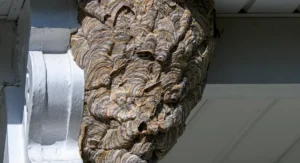
A clear sign of an infestation is the presence of a large, gray, paper-like nest. These nests are often football- or basketball-shaped and found in trees, on buildings, or under eaves. Increased hornet activity around food, garbage, or outdoor spaces can also indicate the proximity of a colony. If you notice hornets aggressively defending a specific area, their nest is probably nearby.

Habitat, Diet, Life Cycle & Behaviors

Understanding the habitat, diet, life cycle, and behaviors of bald-faced hornets can help you avoid conflicts and safely manage their presence.

Where Do Bald-Faced Hornets Live?

A bald-faced hornet’s paper nest

The bald-faced hornet is more likely to build its large, paper nest around areas where humans live, work, and play. These hornets build gray-colored, egg-shaped nests that can become quite large, some growing to 24 inches in length and 30 inches in diameter. Bald-face hornet nests are created in spring and early summer by worker hornets chewing on natural wood fibers and mixing it them with their saliva. Bald-faced hornets will construct nests in trees, under eaves, around light structures on buildings, and inside children’s playhouses. When the nest is finished, it will be the size of a football or basketball.

Diet

Bald-faced hornets primarily feed on live prey and sugary substances. They hunt other insects, such as flies and caterpillars, to feed their developing larvae. Adult hornets, however, prefer nectar, fruit juices, and other sugary liquids. Their attraction to sugary foods often brings them into contact with people, especially during picnics or near garbage cans.

Life Cycle

The life cycle of a bald-faced hornet begins in the spring when a fertilized queen emerges from her winter hiding spot. She builds a small nest and lays her first eggs, which develop into worker hornets. These workers then take over the nest-building and foraging duties while the queen focuses on laying more eggs. Colonies grow throughout the summer and peak in population during late summer or early fall. As temperatures drop, the colony dies off, except for newly mated queens which hibernate and begin the cycle anew the following spring.

Behaviors

Bald-faced hornets are relatively large flying insects. Like Africanized honey bees, they will defend their nests aggressively when they feel threatened. When defending their colony, they release alarm pheromones that signal other hornets to attack, often swarming intruders in coordinated assaults. As well as using pheromones, bald-faced hornets also use body movements, like antennal tapping and vibration signals, to communicate.

These beneficial wasps live in colonies of 100-400, with population sizes peaking at the end of the summer. They wouldn’t be such a threat to humans if they did not nest in attics and cavities found around the home and yard.

Unlike honeybees, bald-faced hornets do not die after stinging. They are also highly active during the daytime, foraging for food and building their nests.

Are Bald-Faced Hornets Dangerous?

Bald-faced hornet stings are venomous and can cause pain and swelling for about 24 hours. People who are allergic to bee stings may have similar reactions to a bald-faced hornet sting. Bald-faced hornets scavenge in trash cans and forage upon food and beverages consumed outdoors. They also consume ripe fruit in yards, farms, and vineyards. In the autumn, due to cooler temperatures and reduced food, wasps seek warm shelter. This is when they are more likely to invade homes.

As with many stinging insects, these pests will sting if they feel threatened or their nest is in danger. In protecting yourself against bald-faced hornets, information is key. But if a nest is located near human activity, it is important to contact an experienced bee exterminator.

How To Get Rid of Bald-Faced Hornets

Eliminating bald-faced hornets requires caution and expertise due to their aggressive nature. Attempting to remove a nest on your own can lead to multiple stings. We recommend you contact a professional pest control company like Florida Pest Control. Our team is trained in safe and effective nest removal methods, ensuring your safety and the complete elimination of the hornet colony.

Bald-Faced Hornet Prevention Tips

To prevent bald-faced hornets from nesting near your home or business:

  • Regularly inspect your property for early signs of nest building, especially during spring and summer.
  • Seal cracks and gaps in walls, soffits, and eaves to eliminate potential entry points.
  • Keep garbage cans tightly sealed and clean up food and drink spills as quickly as you can.
  • Trim trees and shrubs to reduce nesting opportunities near your home.
  • Use yellow outdoor lighting, which is less attractive to flying insects.

Need Help with Bees, Wasps, or Hornets?

If you’ve noticed bald-faced hornet activity on your property or discovered a nest, don’t wait for the problem to escalate. Florida Pest Control offers expert removal services tailored to your specific needs. Contact us today to schedule a free inspection and take the first step toward reclaiming your outdoor spaces.

Frequently Asked Questions

How far do bald-faced hornets travel from their nest?

Bald-faced hornets typically travel up to 200 yards from their nest to forage for food. They prefer to stay close to their colony for protection and efficiency.

Do bald-faced hornets sting?

Yes, bald-faced hornets can sting, and they will do so repeatedly if they feel threatened or if their nest is disturbed. Unlike some bees, they have smooth stingers and do not lose their stinger after stinging.

How bad is a bald-faced hornet sting?

A bald-faced hornet sting can be quite painful due to its venom, which causes localized swelling, redness, and a burning sensation lasting about 24 hours. People with allergies to insect stings may experience more severe reactions.

How aggressive are bald-faced hornets?

Bald-faced hornets are highly aggressive, especially when defending their nest. They will attack perceived threats en masse, making them one of the more defensive stinging insects.

Where do bald-faced hornets nest?

Bald-faced hornets build large, paper-like nests in trees, shrubs, under building eaves, or in other elevated outdoor locations. These nests are usually gray, football-shaped, and can grow quite large over the summer months.