
You’re in the kitchen late at night, the light flickers on, and something small and fast crosses your kitchen counter and vanishes behind the toaster. Was that a bug? Something you’d rather not think about? In Florida, where the climate is a standing invitation to insects of every description, the odds are decent that what you glimpsed was a baby cockroach. The question worth asking isn’t just what it looked like. It’s what finding one actually means.
The Basic Appearance of a Cockroach Nymph
Baby cockroaches are called nymphs, a word that makes them sound considerably more charming than they are. They’re small, typically between one-eighth and one-quarter of an inch long when they first hatch, which puts them somewhere in the neighborhood of a grain of rice. Fresh out of the egg case, they’re pale white or light grey. That coloring doesn’t last. Within a few hours, the shell hardens and darkens to a light or reddish-brown, and the nymph starts to look a good deal more like the cockroach it’s going to become.
The body is flat, oval, and hard-shelled. Six legs and two antennae complete the arrangement, though at the earliest stages of development these features can be so fine they’re difficult to see without a magnifying glass.
One thing baby cockroaches don’t have is wings. Flight is a privilege reserved for adulthood and even then, some species in Florida opt not to bother with it. As the nymph matures and sheds its exoskeleton through multiple molting stages, it gradually looks more and more like a miniature version of the adult.
Telling the Species Apart
Florida hosts a notable variety of cockroach species, and their nymphs don’t all look identical. Knowing which one you’re looking at can help you understand the scale of what you’re dealing with.
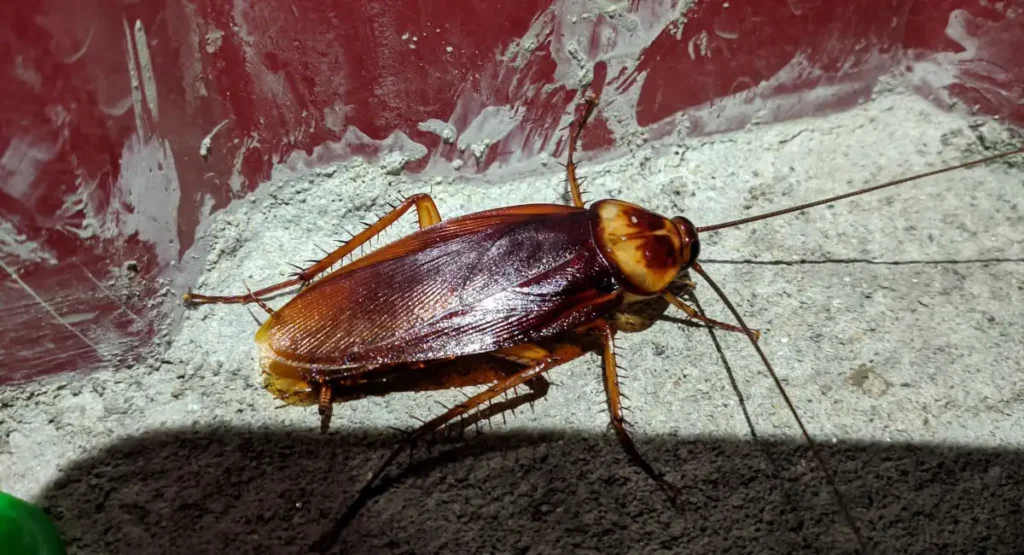
- American cockroach nymphs are reddish-brown with a pale, halo-shaped marking on the section just behind the head. They start small but grow considerably, eventually reaching around two inches as adults after working through up to 13 molting stages. In Florida, the American cockroach is sometimes called the palmetto bug, a rebranding effort that fools nobody.
- German cockroach nymphs are the smallest of the three, starting at just one-eighth of an inch. They’re tan or light brown with two dark, parallel lines running down the plate behind the head. Don’t let their modest dimensions reassure you. German cockroaches are among the most prolific and difficult to control, and finding their nymphs in a kitchen is the kind of discovery that tends to escalate quickly if it isn’t addressed.
- Oriental cockroach nymphs are reddish-brown like the American variety but carry a pattern of alternating light and dark bands across their backs.
Florida also has its share of smoky-brown and brown-banded cockroach nymphs, each with their own subtle identifying features. The details matter less than the conclusion: if you’re seeing nymphs, you’ve already got company.
Are You Sure It’s Not a Bed Bug?
The misidentification of baby cockroaches as bed bugs, and vice versa, is genuinely common. Both insects are small, brownish, and flat enough to disappear into crevices without much effort. A closer look usually clears things up.
Bed bugs are rounder and wider, shaped like a small apple seed. Look carefully and you’ll see they’re flatter than a cockroach nymph. Cockroach nymphs are more elongated and cylindrical. The antennae are the most reliable tell. A cockroach nymph carries antennae that project forward and extend nearly the length of its body. A bed bug’s antennae are short and sit out to the sides, barely noticeable at a glance. Bed bugs also have dark, bead-like eyes that are clearly visible, while cockroach nymphs’ eyes are far less prominent.
Location matters too. If you found it near your mattress, bed bugs are the likelier candidate. If it was near food, water, or somewhere warm and dark in your kitchen, you’re probably looking at a cockroach.
What Finding a Baby Cockroach Actually Means
Here’s the part nobody wants to hear: a single nymph is almost never a single nymph. Baby cockroaches don’t wander into kitchens as curious loners. An egg case can contain dozens of eggs, and a thriving population can build up quickly in a warm, humid Florida home where conditions are rarely less than welcoming to them. Think of the nymph as the visible fraction of a larger situation.
The practical response involves removing what cockroaches are looking for in the first place. Keep food in sealed containers, clean up crumbs and grease promptly, fix any leaks, and reduce clutter in areas where cockroaches like to congregate. Products like boric acid or diatomaceous earth can help manage a smaller infestation, and insect growth regulators can disrupt the development of nymphs before they reach adulthood. For anything beyond a very contained problem, professional pest control is the more reliable path.
Call in the Professionals
For anything beyond a very contained situation—and in Florida, that’s unlikely to be the case—the most effective move is to bring in a professional. Cockroaches are hardy, adaptable, and very good at not being where the treatment is. Florida Pest has the local knowledge and experience to deal with them properly. Contact us and we’ll take it from there.